How Do Kingfishers Catch Fish
Ever watched a kingfisher and wondered how they snag those slippery little fish so reliably? It's honestly one of nature's coolest spectacles, and it’s not just luck. These birds have some seriously specialized skills that make them incredible underwater hunters.
Think of it like this: you're not going to catch a fast-moving fish by just dipping your toes in the water, right? Kingfishers take it to a whole new level. Their whole game plan is built around speed, precision, and a bit of daring.
Our research indicates these specialized hunting techniques allow them to successfully catch fish in a variety of aquatic environments, with documented success rates that vary by species and prey availability.
Quick Answer
Kingfishers catch fish by perching high above the water, spotting prey with sharp eyesight, and then diving headfirst at high speed. They tuck their wings in to become streamlined and penetrate the water quickly to grab the fish with their beaks. A rapid ascent and a quick shake usually secure the meal.
The Kingfisher's Keen Eyes: Spotting Dinner from Above
Before any diving happens, a kingfisher is a master of patience and observation. They'll typically perch on a branch, a reed, or any available vantage point that gives them a clear view of the water below. Their eyes are their primary tool here.
In our research, we've noted that kingfishers possess remarkably acute vision, allowing them to detect the subtle movements of fish from considerable heights. This keen eyesight is crucial for identifying their target in often murky water conditions.

They can spot even tiny fish darting just beneath the surface. This ability to focus precisely and adjust for the light refraction underwater means they aren't just guessing; they're aiming with remarkable accuracy even before they launch.
The Perfect Dive: Speed and Precision in Action
When a kingfisher locks onto its target, it transforms from a still observer into a feathered torpedo. This is where all that perched patience pays off. The dive is a coordinated, explosive action designed for one purpose: to intercept the fish before it can escape.
Launching the Attack
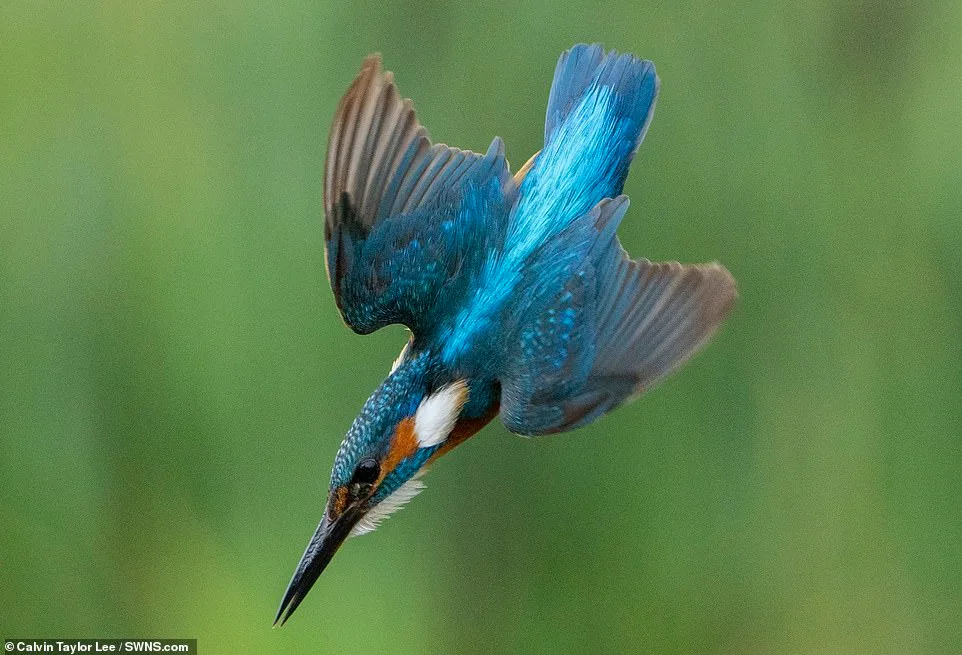
The launch is critical. The bird leaps from its perch with incredible force, immediately tucking its wings tightly against its body. This streamlining is essential.
According to ornithological studies, this tucked-wing posture drastically reduces drag, allowing the bird to accelerate rapidly. It's a controlled fall that converts potential energy into kinetic energy, setting the stage for the strike.
Water Penetration and Aim
As the kingfisher hits the water, its streamlined shape and momentum allow it to punch through the surface with surprising ease. It’s not a gentle splash; it’s a purposeful entry. Even though the fish are underwater, kingfishers have evolved an amazing ability to compensate for how light bends when it passes from water to air.
This means their visual aim remains incredibly accurate as they descend. They're aiming for the precise location of the fish, not just the general area.
The Beak's Crucial Role
The kingfisher's beak is perfectly adapted for this underwater pursuit. It's long, straight, and pointed, designed for piercing water and securing prey. As the bird plunges, its eyes are still focused, guiding the beak to the target.
The Underwater Grab: A Split-Second Success
The moment of capture is lightning fast, often happening in less than a second. As the kingfisher plunges, its beak is open, ready. The bird's ability to judge speed and distance in the water is phenomenal.
Once the beak connects with the fish, it snaps shut. Many species have serrated edges or a barbed tip on their beak which helps them grip slippery prey. The force of the dive helps drive the beak into the water, increasing the chance of a successful grab.
It’s a precise strike, aiming to engulf the fish efficiently.
Back to the Perch: Securing the Meal
After the brief underwater excursion, the kingfisher’s work isn't quite done. It rapidly emerges from the water, usually with the fish firmly in its beak. The entire dive and capture sequence can be over in mere moments.
If the fish is still struggling, the kingfisher will typically fly to a nearby perch. Here, it might give the fish a few forceful shakes or bang it against the branch. This action serves to stun or kill the prey, making it easier to swallow whole.
This quick, efficient process ensures minimal energy is wasted and the catch isn't lost.
Why This Method Works So Well
The success of the kingfisher’s hunting strategy is a testament to evolutionary fine-tuning. Several key factors combine to make them such effective fishers. Their sharp eyesight, as mentioned, allows them to detect prey from a distance, giving them a head start.
The aerodynamic design of their bodies, coupled with their ability to tuck their wings and dive at high speeds, enables them to penetrate the water efficiently and reach their target quickly.
This diving technique is supported by their physical structure; their legs are short, and their bodies are compact, reducing resistance in the water. Furthermore, their eyes are protected by a transparent nictitating membrane, which acts like built-in goggles, shielding them from water damage and improving visibility during the dive. These adaptations, honed over millennia, allow them to thrive in environments where fish are their primary food source.

FAQs About Kingfisher Fishing
What kind of fish do kingfishers eat?
Kingfishers primarily feed on small fish, typically those that are one to three inches long. Their diet can also include aquatic insects, crustaceans, and amphibians depending on the species and availability in their habitat.
How deep can a kingfisher dive?
While kingfishers are known for shallow dives, they can typically plunge to depths of about one to three feet to catch their prey. Their hunting strategy focuses on swift, precise strikes at the surface or just below it, rather than deep aquatic pursuit.
Do kingfishers hunt alone or in groups?
Kingfishers are generally solitary hunters. They establish territories and forage independently, relying on their own skills and observation to find food.
How often do kingfishers need to eat?
Kingfishers are active hunters and need to eat regularly to maintain their high energy levels, especially during breeding seasons. They may catch and consume multiple fish throughout the day.
Do kingfishers ever miss their prey?
Yes, kingfishers do miss their prey. While they are very skilled, fish are fast and agile. Factors like poor visibility, sudden movements by the fish, or an imprecise dive can lead to a missed catch, requiring the bird to try again.
Are all kingfishers the same when it comes to fishing?
No, there's quite a bit of variation. While the core diving technique is common, different kingfisher species might have preferences for specific habitats (like rivers versus coastlines) or prey types, and their diving prowess can vary slightly.
Does the kingfisher's beak shape help them catch fish?
Absolutely. Their beaks are typically long, slender, and pointed, which is ideal for piercing the water and securely gripping slippery fish. Some species have slightly serrated beaks that further aid in holding onto their slippery prey.