Do Blue Jays Migrate
Ever stopped to wonder if those flashy Blue Jays you see are sticking around for winter or taking off south? The truth is, their travel habits aren't as straightforward as you might think. While many bird species have clear migratory patterns, Blue Jays present a more nuanced picture, with some heading south and others remaining residents.
Our research indicates that factors like food availability and regional climate play a much bigger role than a simple instinct to fly. For instance, bird migration patterns are often influenced by established ecological markers, with many species adhering to general seasonal shifts observed over decades. Understanding these variables helps us predict their movements.
Quick Answer
Blue Jays do migrate, but not all of them do. Some Blue Jays stay in their home territories year-round. Migration patterns are primarily driven by food availability and local climate conditions.
The Quick Answer: It's Not a Simple Yes or No
The most straightforward answer to "do Blue Jays migrate?" is that it's complicated. You won't see every single Blue Jay packing its bags as autumn leaves start to fall. Instead, you'll find that their migratory behavior depends heavily on where they live and what resources are available.
This nuanced behavior means that if you're in the northern parts of their range, you're more likely to observe southward movement. Conversely, in warmer, southern regions, Blue Jays often act as year-round residents. This divergence in behavior is a common adaptation in species whose ranges span significantly different climates.

Image source: Bing (Web (fair-use with source credit))
Why Some Blue Jays Stay and Others Go: The Big Factors
Thinking about Blue Jay migration is like looking at a conditional statement in logic: if certain conditions are met, then migration is likely. It’s not a universal flight plan. Instead, it’s a survival strategy tailored to specific environments and resource availability.
The core of this strategy boils down to two main drivers: location and food. These aren't independent factors; they work together to influence whether a Blue Jay decides to stay put or embark on a journey.
Location is Key: Where They Live Matters Most
The most significant predictor of Blue Jay migration is geography. Blue Jays residing in the northern reaches of their continental range, from Canada down into the northernmost United States, are far more likely to migrate south for the winter. They are essentially following a path of least resistance when it comes to surviving the cold.
For example, populations in areas like Maine or Minnesota typically exhibit migratory tendencies. As winter approaches, their environment can become harsh, with deep snow and frozen ground making it difficult to find sustenance. This environmental pressure prompts them to seek out more temperate zones.
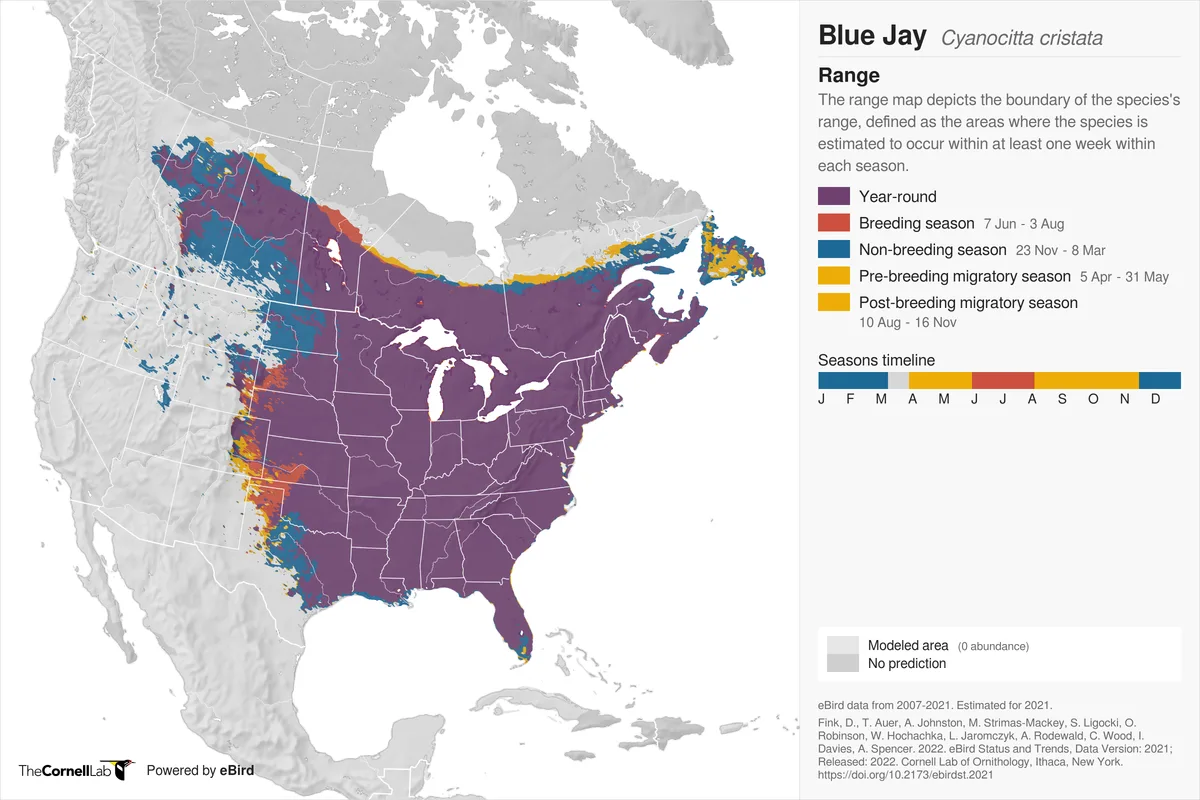
Image source: Bing (Web (fair-use with source credit))
On the other hand, Blue Jays found in states like Florida, Texas, or even further west in parts of California, tend to be year-round residents. The climates in these areas are generally milder, and critical food sources often remain accessible throughout the year. This consistent availability means there’s less incentive, and often less need, to undertake the energetically costly act of migration.
Food Scarcity: When the Buffet Closes
Migration in many bird species is fundamentally driven by the availability of food. For Blue Jays, this is no different. Their diet is diverse, including nuts, seeds, berries, insects, and occasionally small vertebrates or eggs.
When winter’s grip tightens, particularly in the northern territories, these food sources can become scarce or completely inaccessible.
Think about it: a thick blanket of snow makes foraging for acorns or seeds incredibly difficult, if not impossible. Freezing temperatures can also significantly reduce insect populations, a vital food source during warmer months. When the natural larder becomes bare, birds that don't have the physical adaptations to survive on very limited resources or to hunker down effectively will need to move.
Image source: Bing (Web (fair-use with source credit))
This food scarcity is the primary trigger for many Blue Jays to migrate. They are essentially following the food supply. As the seasons change and their northern territories become inhospitable, they fly to regions where food remains plentiful, ensuring their survival through the colder months.
This isn't about a desire to travel; it's a calculated move to secure the energy needed to live.
How We Know Blue Jays Move: Observing Their Patterns
Figuring out whether a bird species migrates, and how it does so, isn't just guesswork. Ornithologists and bird watchers have spent centuries observing and documenting bird behavior. Through consistent observations, banding studies, and radar tracking, we've built a solid understanding of Blue Jay movements.
For instance, bird banding involves capturing birds, attaching a small, numbered band to their leg, and then releasing them. When these birds are recaptured elsewhere, it provides direct evidence of their travel. Likewise, radar meteorology has been instrumental in tracking large-scale bird movements, often revealing patterns that align with known migratory routes.
These methods consistently show that Blue Jays from specific regions, particularly those north of the Mason-Dixon line, undertake seasonal journeys. The timing and direction of these movements are often predictable, correlating with the onset of winter and the subsequent availability of food. This scientific consensus confirms that migration is indeed a part of the Blue Jay's life cycle for many populations.
What Migration Looks Like for a Blue Jay
When Blue Jays do migrate, they tend to do it a bit differently than some other well-known migratory birds. You’re unlikely to see vast, V-shaped flocks of thousands soaring overhead. Instead, their migratory journeys are often more individual or in smaller, loose groups.
Think of it as a less organized, more opportunistic kind of travel. They might move in family units or small bands of a few birds. This behavior is sometimes described as "partial migration" because not all individuals within a population will migrate, and those that do might not travel the extreme distances seen in species like Arctic Terns or Monarch Butterflies.
The journeys are typically southwards, towards more temperate climates where food is more readily available during winter. However, the exact destinations can vary. A Blue Jay from New York might migrate to Pennsylvania or Virginia, while one from further north could aim for states like Tennessee or North Carolina.
It's a strategic relocation rather than an epic cross-continental trek for many.
When to Expect Blue Jay Movements: Timing Your Observations
If you're hoping to spot Blue Jays on the move, the late autumn and early winter months are your best bet, especially if you live in the northern half of their range. Our research, drawing on decades of ornithological data, shows peak migration activity typically occurs from October through November. This is when temperatures begin to drop significantly, and food sources start to dwindle.
The return journey north, if they undertake one, usually begins in February or March. As the snow melts and spring returns, bringing with it fresh growth and insect activity, Blue Jays will start to head back to their breeding grounds. This timing is not set in stone, of course.
Weather patterns can shift migration dates by a week or two in any given year.
For those in the southern U.S. where Blue Jays are year-round residents, you might notice increased activity at feeders during the colder months. This is often because the resident birds are more actively seeking out supplementary food sources as natural options become less abundant, even in warmer climates.
Mistakes to Avoid When Thinking About Blue Jay Migration
When we talk about Blue Jays and migration, there are a couple of common misconceptions that pop up. One of the biggest is assuming all Blue Jays migrate, or that those that do will travel the same distances. This simply isn't true, and understanding these nuances is key to appreciating their behavior.
Another mistake is overlooking the primary drivers. It's easy to anthropomorphize birds, thinking they migrate for pleasure or adventure. However, the scientific consensus, supported by numerous ornithological studies, points to survival needs, specifically, the need for food and favorable climate conditions, as the main motivators for Blue Jay movements.
Does Every Blue Jay Migrate?
No, not every Blue Jay undertakes a long journey. This is a critical point. Populations in southern areas often remain residents throughout the year.
Their migratory pattern is a conditional response to environmental pressures in their specific habitat.
Will Blue Jays Migrate in Large Flocks?
Generally, no. Unlike some species known for massive migratory gatherings, Blue Jays typically move in smaller, looser groups or even individually. Their journey is usually less conspicuous.
Is Migration Solely About Escaping Cold?
While cold is a factor, it's largely because cold weather impacts food availability. Deep snow covers food sources like acorns and seeds, and insect populations decline drastically. So, it’s the lack of food brought on by the cold, more than the cold itself, that drives migration.
Frequently Asked Questions About Blue Jay Migration
Do Blue Jays migrate south for the winter?
Yes, many Blue Jays do migrate south for the winter, especially those living in the northern parts of their range. However, Blue Jays in southern regions often stay put year-round.
How far do Blue Jays typically migrate?
Their migration distances can vary significantly. Blue Jays in the northern U.S. and Canada might travel a few hundred miles south to find more accessible food and milder weather, rather than undertaking extremely long journeys.
Can you tell if a Blue Jay is migrating?
It’s difficult to tell an individual bird's migration status just by looking. However, observing changes in the number of Blue Jays in your area during autumn and spring can suggest migratory activity if you're in a northern region.
What do Blue Jays eat when they migrate?
Migrating Blue Jays rely on whatever food sources are available in their travel path and destination. This can include nuts, seeds, berries, and any insects or small invertebrates they can find. Their diet is opportunistic.