Why Do Birds Fly in Groups
Birds fly in groups for real, measurable reasons. It's not random behavior or mere habit. Why do birds fly in groups?
The answer centers on three advantages: saving energy, staying safe from predators, and navigating long routes more accurately.
The numbers are striking. V-formation flight can reduce a bird's energy use by up to 15% compared to flying alone. That matters when you're covering thousands of miles across continents.
Group flight shows up everywhere, from goose migration patterns to starling murmurations overhead. Different birds fly together for different reasons.
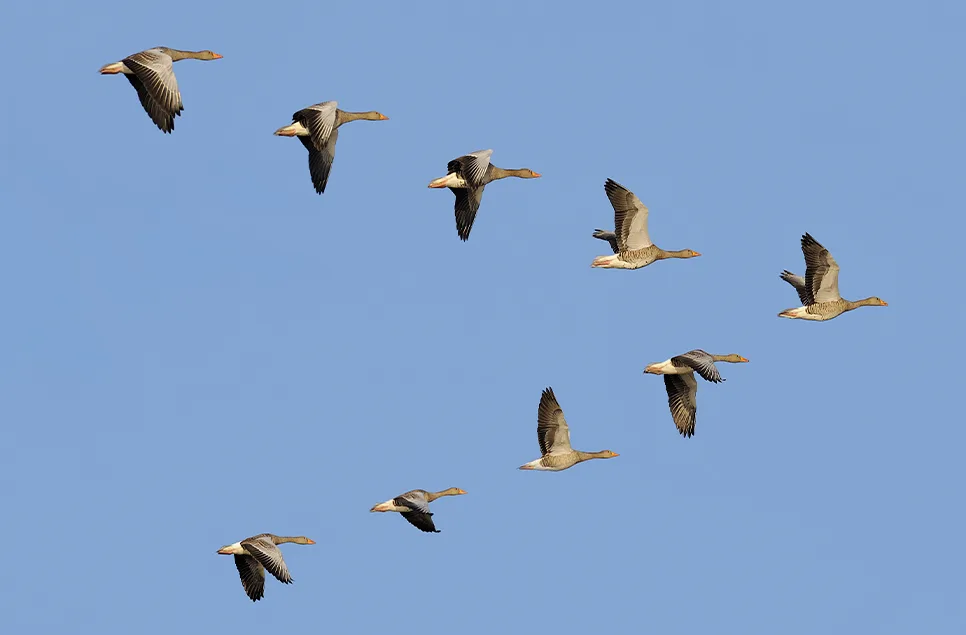
Image source: Bing (Web (fair-use with source credit))
Quick Answer
Birds fly in groups to save energy, avoid predators, and navigate more accurately. V-formation flights cut energy use by up to 15%. Murmurations confuse predators through sheer numbers.
Experienced lead birds guide the group along proven migration routes.
The Short Answer: Why Do Birds Fly in Groups?
When you watch birds fly in groups, you're seeing a combination of survival strategies at work. Each one serves a different purpose, and different species lean on different combinations.
Here are the three main reasons:
| Reason | What It Does | Best Example |
|---|---|---|
| Energy savings | Reduces drag through aerodynamic upwash | V-formation (geese, pelicans) |
| Predator defense | Makes it hard to single out one target | Starling murmurations |
| Navigation | Helps younger birds learn proven routes | Migratory flocks (geese, cranes) |
Energy savings is the most studied benefit. When a bird flies in a V-formation, it positions itself behind and to the side of the bird ahead. This lets it ride the rising air current created by the leading bird's wingtips.
The result is up to a 15% reduction in energy expenditure during long flights.
Predator defense works differently. A dense flock of thousands of birds creates what's called the confusion effect. A hawk diving into a murmuration can't easily focus on a single target.
The whole group moves as one shifting mass, and the predator loses track.
Navigation is the third piece. Young birds learn migration routes by following experienced leaders. This social learning keeps populations returning to the same breeding and feeding grounds year after year.
V-Formation: How Aerodynamics Explains the Classic V-Shape
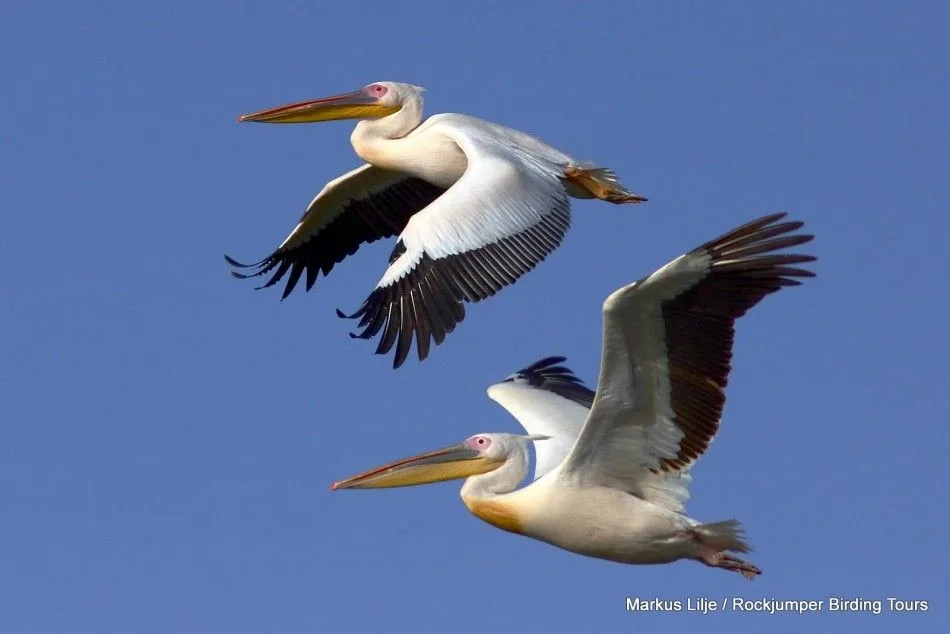
Image source: Bing (Web (fair-use with source credit))
The V-formation is one of the most recognizable sights in bird flight. Geese, pelicans, cormorants, and some cranes fly this way on long journeys. It looks elegant, and it is.
But it's also a brilliant piece of aerodynamic engineering.
Here's what's happening under the wings. As a bird flies forward, its wings push air downward and backward. This creates two spiral air currents trailing behind the wingtips, called wingtip vortices.
The air on the outside of these spirals rises.
That rising air is called upwash. A bird flying behind and to the side of the leader can position itself to catch this upwash. The effect reduces the effort needed to stay aloft.
Pennycuick's research in the 1960s and 1970s first established the aerodynamic model for this. Modern studies have confirmed that optimal spacing sits 1 to 2 wingspans behind the bird ahead.
One interesting detail: the lead bird actually works harder. It breaks the air for everyone behind it. That's why flocking birds rotate leadership mid-flight.
Taking turns keeps the whole group fresh over thousands of miles.
Murmurations: The Predator Confusion Strategy Behind Starling Swarms
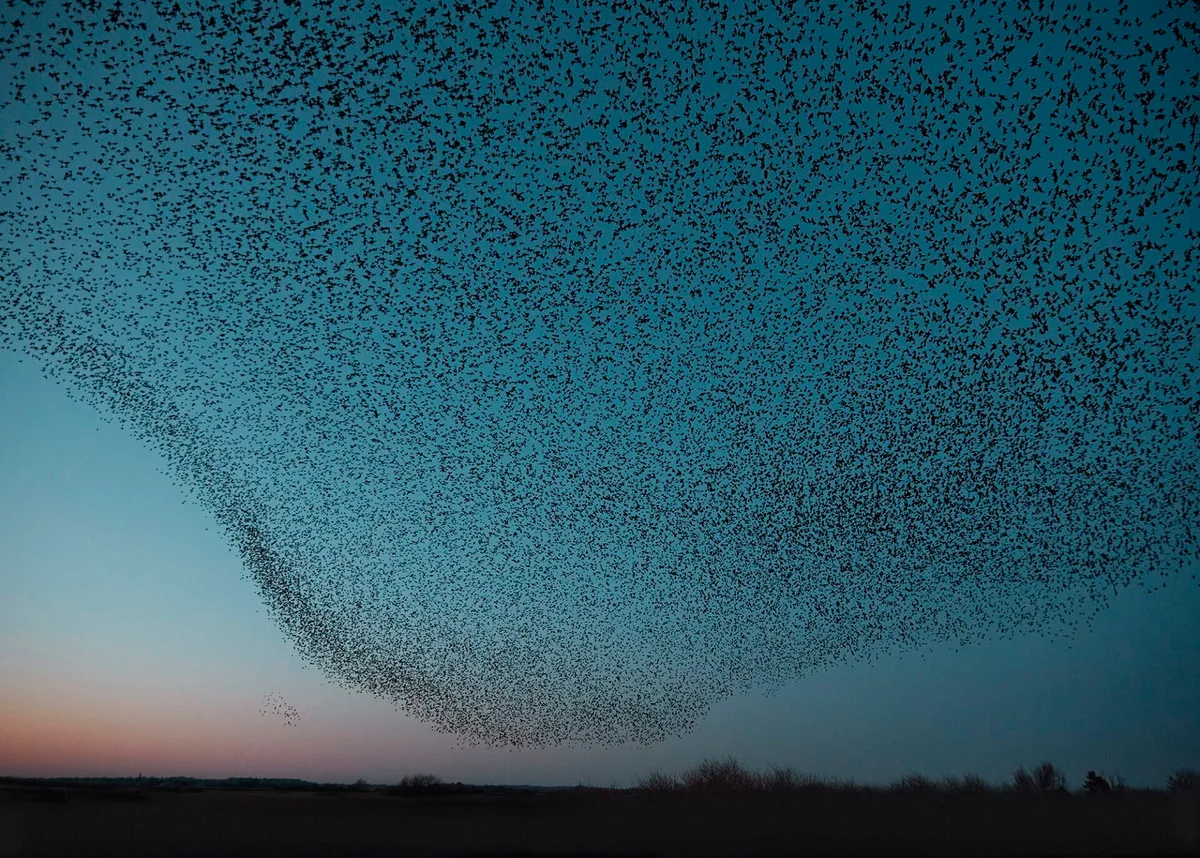
Image source: Bing (Web (fair-use with source credit))
A murmuration is the swirling, shifting mass that starlings form in the sky, usually at dusk. A single flock can number in the tens of thousands. The whole cloud moves in near-perfect unison, pulsing and reshaping like a living thing.
The function is survival. A hawk targeting a murmuration faces what biologists call the confusion effect. With thousands of birds moving in unpredictable patterns, the predator can't lock onto a single target.
Its odds of a successful strike drop dramatically.
What makes murmurations remarkable is their responsiveness. Each bird reacts to its nearest neighbors, not the whole flock. Craig Reynolds' boids model from 1987 showed that simple rules, like "avoid collisions" and "match your neighbors' speed," produce complex group behavior.
The result is real-time swarm intelligence. There's no leader directing the murmuration. It emerges from thousands of individual decisions made in fractions of a second.
Murmurations aren't just starling behavior either. Similar swirling flocks show up in shorebirds and sandpipers when predators are present.
How Birds Know Where to Go: Leadership, Navigation, and Social Learning
Flocking isn't just about energy and safety. It's also about knowledge transfer. Older, more experienced birds hold the map, so to speak.
Younger birds learn the route by following them.
Research from the Cornell Lab of Ornithology shows that migratory species like geese and sandhill cranes pass route knowledge from one generation to the next. Birds aren't born knowing where to go. They learn it through years of following the flock.
Navigation itself involves multiple senses. Many birds use the Earth's magnetic field as a kind of internal compass. They also track landmarks, the position of the sun, and even star patterns at night.
Flocking amplifies all of these abilities. A group has more eyes scanning the sky.
Social learning explains why flocks behave differently depending on their composition. A group led by experienced birds will take a different flight path than one led by younger birds. This is why [U.S.
Fish & Wildlife Service](https://www.fws.gov/) programs pay close attention to flock demographics. Losing experienced individuals can disrupt migration patterns for years.
As of 2026, satellite tracking studies continue to reveal just how sophisticated this social knowledge is. Birds that migrate alone, like some solitary hawk species, rely entirely on their own navigation. It works, but it lacks the safety net that groups provide.
What Visual Patterns Reveal About the Reason Behind the Flock
The pattern you see in the sky tells you a lot about why those birds are flying together. Three patterns dominate.
V-formation or echelon: This tells you the birds are on a long-distance flight, likely migration. The formation is built for energy efficiency. If you see geese in a V-shape heading south in fall, they're conserving energy on a long haul.
Loose cluster or scattered flock: This pattern usually means foraging. Birds flying in loose groups are covering ground, looking for food. You'll see this with blackbirds, ducks, and shorebirds.
There's no aerodynamic benefit here.
Swirling mass or murmuration: This is the predator response. Dense, rapidly shifting flocks indicate a bird of prey is nearby. The tighter the swirl, the higher the perceived threat.
| Pattern | Shape in Sky | Likely Purpose |
|---|---|---|
| V-formation | Angled V or echelon | Migration, energy savings |
| Loose cluster | Scattered dots | Foraging, ground covering |
| Swirling mass | Dense, shifting cloud | Predator defense |
| Line formation | Single file, low altitude | Low-level travel, wind shelter |
Understanding these patterns doesn't require specialized equipment. Binoculars help, but even with the naked eye, the difference between a V-formation and a murmuration is pretty clear once you know what to look for.
Not All Birds Fly Together: When Flocking Doesn't Apply
Plenty of birds fly solo. Raptors like ospreys, eagles, and owls are classic examples. They're built for solitary hunting, and their wing shapes, talons, and visual acuity are all geared toward a different strategy than flocking.
Falcon species fall into the same category. A peregrine falcon dives at speeds over 200 mph to strike prey alone. Grouping would only interfere with that precision hunting style.
The same goes for most hawks that hunt along forest edges and open fields.
So why don't these birds flock? Their survival model doesn't need it. Solitary predators have low energy costs and high success rates when hunting alone.
The trade-offs that make flocking worthwhile don't apply to their biology.
There are exceptions to the pattern. Vultures often soar together on thermals, sharing rising air currents without competing. They're not really flocking in the social sense, though.
They're just using the same thermal.
| Bird Type | Flocks? | Primary Survival Strategy |
|---|---|---|
| Geese, ducks, starlings | Yes | Energy savings, safety, navigation |
| Osprey, eagle, owl | No | Solitary hunting |
| Vultures | Shared soaring | Thermal utilization |
| Peregrine falcon | Rarely | High-speed precision hunting |
If you're out birdwatching and see a bird flying alone, it's not doing something wrong. It's doing exactly what its species evolved to do.
Common Misconceptions About Bird Flock Behavior
One of the biggest misunderstandings is that all bird flocks work the same way. They don't. A goose V-formation and a starling murmuration are completely different strategies serving completely different purposes.
People also assume flocks always mean safety. That's only half true. Larger groups do offer protection, but they also attract more predators to the area.
The confusion effect helps, but it doesn't make a flock invincible.
Another common error is thinking the lead bird stays in front forever. Research shows flocking birds rotate positions regularly. Taking turns at the front keeps any single bird from exhausting itself during long migrations.
Some folks assume young birds lead their flocks. The reality is the opposite. Experienced adults guide migrations.
Juveniles learn the route by following. This is well-documented in species like sandhill cranes and snow geese.
A quick reference for the most frequent mistakes:
- Assuming all flocking behavior is the same
- Believing the lead bird never rotates positions
- Thinking murmurations and migration formations are interchangeable
- Assuming larger flocks are always more efficient
- Expecting every bird species to flock
The more you watch flocking birds with this framework in mind, the more sense it all makes. The patterns are consistent once you know what each one is actually doing.
Frequently Asked Questions
Why do geese fly in V-formation?
Geese fly in V-formation to save energy on long migrations. The lead bird breaks the wind for everyone behind it. Trailing birds ride the rising air current called upwash.
Research shows this can reduce energy expenditure by up to 15%. Geese also rotate leadership during flight so no single bird tires out.
How do birds fly in groups without colliding?
Birds use a combination of sharp vision, quick reflexes, and simple behavioral rules. Each bird tracks the movements of its nearest neighbors and adjusts its speed and position accordingly. The boids model from Craig Reynolds demonstrated that simple rules like "maintain minimum distance" produce safe, coordinated group flight.
What is a murmuration?
A murmuration is the swirling flight pattern that starling flocks create, usually at dusk. A single murmuration can contain tens of thousands of birds. The formation serves as a defense against predators.
The shifting cloud confuses hawks and falcons, making it hard to single out one target for an attack.
Do all bird species fly in groups?
No, not all birds flock. Solitary hunters like ospreys, eagles, owls, and peregrine falcons rarely fly in groups. Their hunting strategies work better alone.
Most waterfowl, starlings, and shorebirds do flock, though, because their survival depends on the energy savings and safety that group flight provides.
What time of year do birds fly in groups?
Flocking peaks during spring and fall migration, when birds travel between breeding and wintering grounds. In winter, many species also form large roosting flocks for warmth and predator protection. Murmurations are most visible in autumn and winter evenings across Europe and parts of North America.
Why don't some birds migrate in groups?
Some birds, like certain raptors, migrate individually because they rely on soaring thermals rather than flapping flight. Others, like many songbirds, migrate at night alone. Their survival strategies don't require the aerodynamic or navigational benefits that group migration provides for waterfowl and cranes.