Types of Falcons
Understanding the different types of falcons allows you to appreciate these aerial predators with much more clarity. Whether you are a casual backyard observer or a budding birder, identifying these raptors becomes easier once you know what to look for in the wild.
Falcons are members of the family Falconidae, a group defined by their incredible speed and specific hunting behaviors. As of 2026, conservation data from The Cornell Lab of Ornithology confirms that these birds play a critical role in local ecosystems by regulating rodent and small bird populations.
Quick Answer
Common types of falcons include the American Kestrel, Peregrine, and Merlin. They feature pointed wings and stiff flight styles. You can identify them by their distinct facial markings.
Each species prefers specific habitats like cliffs, grasslands, or forests. These birds are raptors that hunt during daylight hours.
Why Identifying Falcons Requires a Visual-First Approach
Identifying falcons in the field is a test of observation rather than memory. You cannot rely on a checklist alone because these birds move too fast for you to scan every feather. Instead, experts suggest you focus on the silhouette, the way the bird moves, and the surrounding habitat.
Visual cues act as your primary identification tool. A bird perched on a wire in a wide-open field suggests a different species than one zipping through a dense forest edge. If you ignore the context of the environment, you risk misidentifying a falcon as a different type of hawk.
Take note of the "jizz," a term birders use to describe the overall impression of a bird. This includes its shape, its posture, and its flight style. When you master these visual elements, you won't need to get close to confirm the species.
The Anatomy of a Falcon: Key Features to Scan
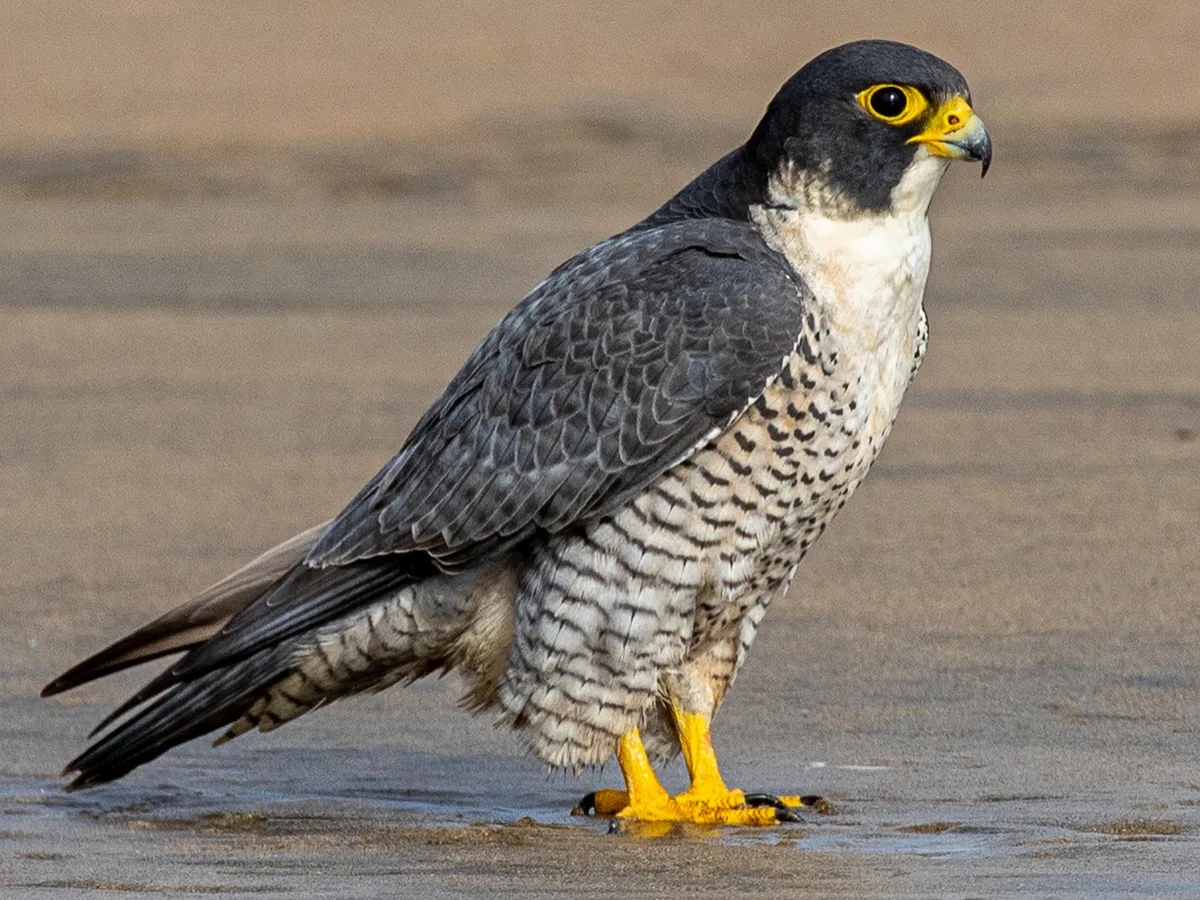
Falcons possess unique physical traits that distinguish them from other raptors. If you manage to get a decent look through binoculars, you should check for a few specific markers. The most notable feature is the tomial tooth.
This is a specialized notch on the upper beak that allows the bird to snap the neck of its prey. While it is hard to see from a distance, the blocky, helmet-like head shape is easier to spot. This shape is a result of the bird's powerful jaw muscles.

Image source: Web (Bing) / redandthepeanut.blogspot.com (Web image (fair-use with source credit))
You should also look for a malar stripe, which is a dark patch of feathers extending down from the eye. It looks like a mustache and helps reduce glare from the sun during high-speed hunts.
Comparing Falcons to Accipiters and Other Raptors
A common mistake for beginners is confusing falcons with accipiters, such as the Cooper's Hawk or Sharp-shinned Hawk. Accipiters are built for maneuverability in forests, while falcons are built for speed in open spaces.
| Feature | Falcon | Accipiter |
|---|---|---|
| Wing Shape | Long and pointed | Short and rounded |
| Tail Shape | Tapered/Pointed | Long and rounded |
| Flight Style | Fast, stiff, direct | Flap-flap-glide |
| Head Shape | Blocky/Helmet | Small/Protruding |
The primary difference lies in the wing tips. Falcons have wings that sweep back to a sharp point, allowing them to tuck in and dive at high speeds. Accipiters have broader, rounded wings that act like paddles for quick turns through tree branches.

Image source: Bing (Web (fair-use with source credit))
Field Identification: How to Read a Silhouette and Flight Pattern
You can often identify a falcon before you see its color. Falcons typically engage in "stooping," which is a high-speed dive from a high altitude to strike prey. This flight pattern is nearly impossible to mistake for the lazy, circling flight of a Buteo hawk.
When a falcon is in active flight, look at the wingbeats. Falcons tend to use fast, shallow, and stiff wingbeats. They rarely soar in wide, lazy circles like Red-tailed Hawks.
If you see a small bird hovering in one spot against the wind, you are likely looking at an American Kestrel.
If the bird is flying low and weaving through obstacles, it might be a Merlin. These falcons do not hover as much as Kestrels; they rely on surprise and sheer speed to capture small songbirds mid-flight. Always observe how the tail interacts with the flight path.
A long tail provides extra steering, which is a key trait for these agile hunters.
Understanding the Big Three: Kestrels, Peregrines, and Merlins
Most falcon sightings in North America fall into three main categories. Each has a distinct personality and preference for hunting grounds. You will find that knowing their preferred environment narrows down your choices significantly.
The American Kestrel is the smallest and most widespread falcon. You will often see them on power lines or hovering over fields. They are about the size of a Mourning Dove, making them easy to spot near rural roads.
The Peregrine Falcon is the world's fastest animal, capable of reaching speeds over 200 mph during a dive. They have adapted to urban environments by using tall buildings as surrogate cliffs. They are medium-sized and feature a very dark, heavy facial "helmet" pattern.
The Merlin is a small, compact, and fierce hunter. They lack the striking, colorful plumage of the Kestrel and the bold facial markings of the Peregrine. They are essentially a blur of dark, muscular motion when they pass by.
Focus on their erratic, high-speed flight to tell them apart from other small raptors.
Common Identification Mistakes and How to Avoid Them
You will often struggle when trying to distinguish between juvenile birds. Young falcons frequently exhibit different plumage patterns than adults, which makes them look like entirely different species. Always focus on the silhouette and flight behavior first.
Don't assume a bird is a hawk simply because it is sitting in a tree. Falcons will occasionally hunt from perches. Check the beak shape through your optics if you can.
A falcon's beak looks shorter and more angular than the hooked, heavy bill of a Buteo hawk.
Avoid the temptation to guess if you aren't sure. If the distance is too great or the lighting is poor, mark the sighting as "Falcon species" and move on. Attempting to force an ID based on a blurry photo often leads to frustration.
Trust your gut only after you have verified at least two key field marks.
Essential Ethics and Safety for Raptor Observation
Your presence as an observer should never alter the behavior of the bird. Raptors are sensitive to movement, especially when they are guarding a nest or feeding. Keep your distance at all times to prevent causing the falcon to abandon its hunt.
Avoid using loud calls or playback devices to attract birds for a better look. This is intrusive and can stress the animal during critical breeding seasons. Official guidelines from the [U.S.
Fish and Wildlife Service](https://www.fws.gov) emphasize that minimizing disturbance is essential for the long-term health of these populations.
If you are using a camera, keep your flash off and stay behind natural cover if possible. Never approach a bird that appears injured. If you spot a raptor with a visible wound, contact your local wildlife rehabilitation center or the regional game warden instead of attempting a rescue yourself.
Frequently Asked Questions About Falcon Species
How fast can a Peregrine Falcon actually dive?
A Peregrine Falcon can reach speeds exceeding 200 mph during a hunting dive. This maneuver is known as a stoop. Gravity and streamlined body shape allow them to generate this extreme velocity.
It is the fastest speed recorded for any animal on the planet.
Are all falcons migratory birds?
Not all falcon species migrate in the traditional sense, though many travel based on food availability. Some populations of Peregrines are permanent residents if their urban or coastal habitat provides year-round prey. Others, like the Merlin, often move south when northern prey becomes scarce in winter.
Can I attract falcons to my backyard?
Attracting falcons usually requires having a large, open area with abundant prey, such as small birds or rodents. Do not attempt to lure them with food, as this disrupts their natural hunting instinct and can lead to dangerous habits. Simply maintaining a healthy, native habitat is the best way to encourage their presence.
What is the difference between a male and female falcon?
In most falcon species, females are significantly larger than males. This is known as sexual dimorphism. In some cases, the female may be up to 30 percent larger and heavier.
Plumage color can also vary by gender, especially in the American Kestrel, where males show distinct blue-grey wing patches.
How do falcons protect their nests?
Falcons do not build traditional nests made of sticks. They prefer to use existing ledges, cavities, or the abandoned nests of other birds. They defend these sites aggressively.
You may hear loud "cacking" calls if you get too close, which is a clear warning to back away immediately.