Bird Flock Behavior
Bird flock behavior is one of the most studied phenomena in animal science. Yet most people still think flocks follow a leader. They don't.
Every bird in a flock monitors only a handful of nearby neighbors, and the whole group organizes itself through simple local rules.
Research shows each starling tracks roughly 5 to 7 neighbors during flight. That's the key number behind murmurations that can hold 35,000 birds together at speeds over 15 mph. Let's look at what's actually going on up there.
Quick Answer
Bird flock behavior is the collective movement of birds organized by simple local rules, not by a leader. Each bird monitors 5 to 7 nearby neighbors. Birds align direction, keep distance, and move toward the flock center.
This creates self-organizing groups like starling murmurations and pigeon flocks. Research dates flock behavior studies to 1986 and beyond.
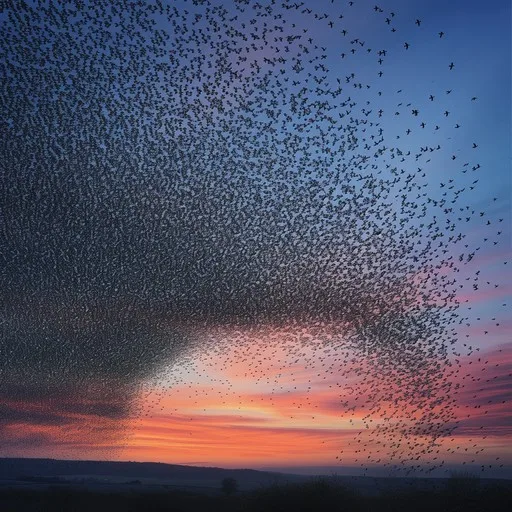
Image source: Bing (Web (fair-use with source credit))
What Bird Flock Behavior Really Looks Like
A bird flock doesn't look like what most people assume. There's no single bird making decisions for the group. Instead, thousands of individuals each respond to what the birds closest to them are doing.
You'll see this most clearly in starling murmurations, the massive evening displays over European cities. As of 2026, the most studied murmuration remains the Rome population over the Tiber River. Flocks there regularly number in the tens of thousands and shift shape in under two seconds.
The same principles show up everywhere. Flocks form for three main reasons:
- Predator defense, More eyes means faster threat detection. Research on cliff swallows found a 25% drop in predator success rates for birds in flocks compared to solitary foragers.
- Energy savings, In V-formation flight, birds save roughly 20 to 30% of their energy compared to flying solo. The Cornell Lab of Ornithology has documented this clearly in geese and pelicans.
- Information sharing, A flock acts as a distributed search engine. When one bird finds food, others quickly follow.
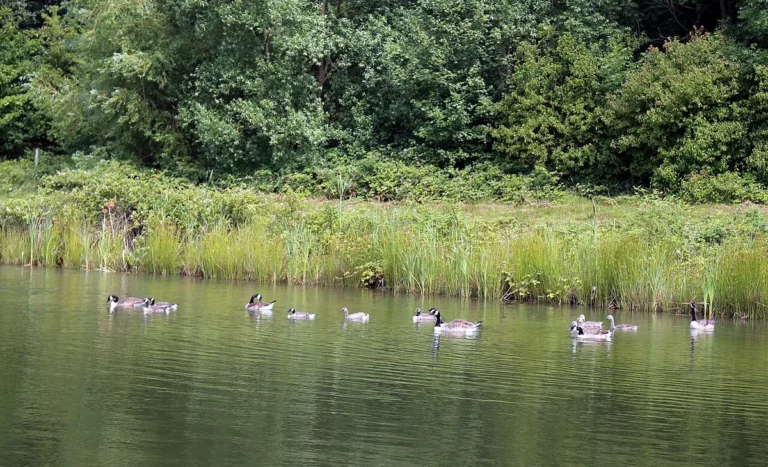
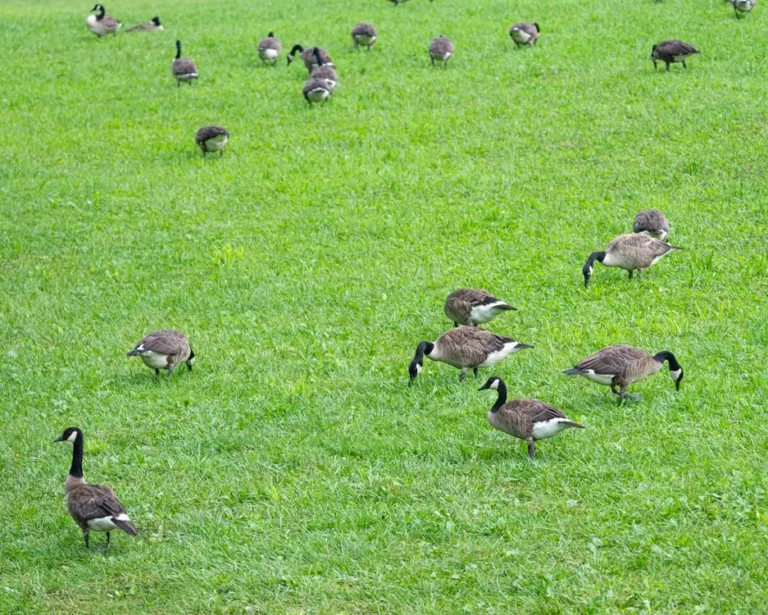
Ground-feeding flocks like finches and sparrows show the same logic on a smaller scale. They're easier to observe and just as interesting.
The Science of Flocking: Local Rules, Neighbor Counts, and Self-Organization
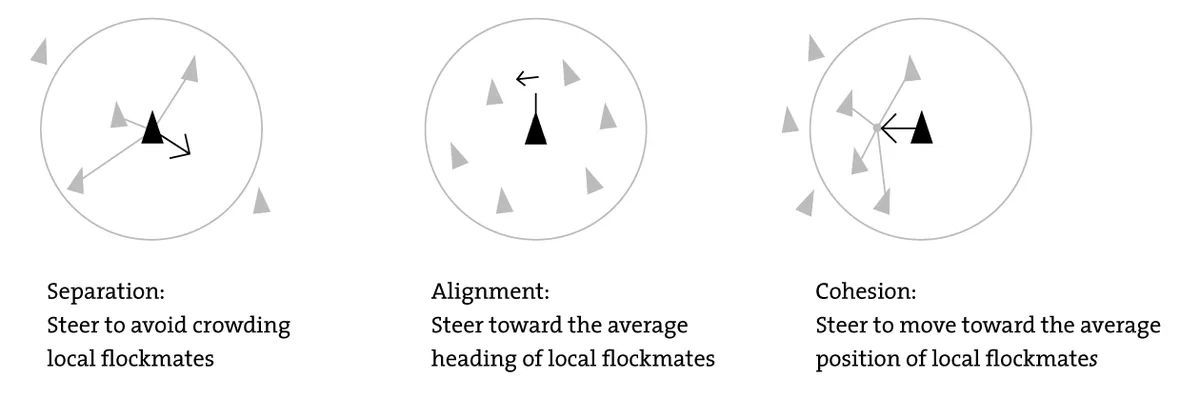
Image source: Bing (Web (fair-use with source credit))
In 1986, computer scientist Craig Reynolds created a model that explained flock behavior using just three rules. He called it "Boids." The model still stands as the foundation for swarm behavior research.
The three rules are simple:
| Rule | What It Means |
|---|---|
| Alignment | Steer toward the average heading of nearby birds |
| Cohesion | Steer toward the average position of nearby birds |
| Separation | Avoid colliding with close neighbors |
Each bird follows only these three rules, using data from 5 to 7 immediate neighbors. There's no central command. No bird plans the whole formation.
The complex murmuration patterns emerge from thousands of tiny local adjustments.
Scientists later confirmed the neighbor-count figure in field studies. Per research from the Rome pigeon experiments, starlings track an average of 7 neighbors when the flock is dense, dropping to 5 when it thins out.
The turn-speed threshold matters too. If any bird turns faster than its neighbors can follow, the flock destabilizes. That's why murmurations look like they pulse and split.
The group hits its physical limits, then re-forms.
Reynolds' boids model has since influenced robotics, drone swarm engineering, and AI pathfinding. The biological insight is that complex global order comes from simple local decisions.
Landmark Flock Studies: Rome's Pigeon Experiment and Starling Murmuration Data
Image source: Wikimedia Commons / José Moutinho from Leça da Palmeira, Portugal (CC BY)
Two research projects stand out in flock behavior science. Both came out of Rome.
The Rome Pigeon Experiment
In the late 1990s and early 2000s, a team led by researchers at the University of Rome tracked flocks of over 1,000 homing pigeons using high-resolution GPS. They released trained pigeons in flocks of different sizes and mapped each bird's flight path.
The results changed how we think about group decision-making. Flocks made fewer directional changes than individuals flying alone. Yet the flock's path wasn't a simple average of the group.
Instead, the birds most experienced at navigation took disproportionate influence over the route.
This wasn't leadership by force. It was influence earned through flight performance. Weaker navigators naturally gravitated toward positions that let them follow stronger flyers.
Starling Murmuration Research
Field studies of European starlings, published in journals like Physical Review Letters and Nature, confirmed the murmuration dynamics at scale. Researchers in Rome recorded murmurations using multiple cameras positioned around the Tiber Valley.
Key findings from this research:
- Flocks regularly held 1,000 to 10,000 birds in stable formations.
- Turn events propagated through the flock in milliseconds.
- Split-and-rejoin patterns occurred when density dropped below a threshold.
- Asymmetric left-biased turns appeared more often than right turns, a pattern no one has fully explained yet.
This work laid the groundwork for the neighbor-count and turn-speed data we now take for granted.
The Upside and the Risk: Why Flocking Works and When It Doesn't
Flocking is a survival strategy. It works because it scales intelligence across a group. But it has real limits.
Where Flocking Wins
- Predator dilution, Your chance of being the one caught drops as flock size grows. This is simple math.
- Thermal regulation, Dense winter roosts can raise ambient temperature by 2 to 3 degrees inside a cliff swallow colony.
- Navigation accuracy, Migrating flocks outperform individuals at reaching distant destinations. Studies on white ibis in Florida showed group flights arrived more consistently than solo flights.
- Faster threat response, Starlings react to predator movement in roughly 100 milliseconds. That's faster than any solo bird's visual processing.
Where Flocking Fails
- Density limits, Above certain densities, flocks lose cohesion. Turn-speed thresholds get exceeded. The group splits.
- Roost site stress, Massive urban pigeon roosts, numbering in the hundreds of thousands, transmit disease more easily. Avian diseases spread faster in dense roosting sites.
- Agricultural conflict, Large flocks can strip crops fast. Quelea flocks in sub-Saharan Africa can devastate grain harvests overnight.
- Bird strike risk, Flocks are a primary aviation hazard. Per the FAA, bird strikes cost US airlines hundreds of millions annually.
The takeaway? Flocking is powerful but not infinite. The same mechanisms that protect a starling can concentrate risk when birds gather in extreme densities.
Who Uses Flock Behavior Research: From Birdwatchers to Drone Engineers
Flock behavior research isn't just academic. It reaches a surprisingly wide range of fields.
| Field | How They Use Flock Research |
|---|---|
| Wildlife conservation | Designing roost site protection and habitat management plans |
| Aviation safety | Modeling bird strike risk at airports using flock movement data |
| Robotics and drones | Applying boids algorithms to coordinate autonomous drone swarms |
| Game and AI development | Building realistic non-player character behavior using flocking rules |
| Agriculture | Predicting crop damage timing based on flock arrival patterns |
| Ecotourism | Identifying murmuration hotspots for guided tours |
| Ecological education | Teaching self-organization concepts through nature observation |
The Royal Society for the Protection of Birds has published detailed guidance on protecting roosting sites based on this research. Their work directly supports UK conservation policy.
Drone engineering is one of the fastest-growing applications. Engineers at multiple universities use boids-style algorithms to coordinate drone fleets without centralized control. The same three rules that keep starlings together keep swarms of autonomous vehicles on course.
For birdwatchers, understanding flock behavior transforms the experience. You stop seeing a blob in the sky and start reading the dynamics. You can tell when a flock is reacting to a raptor.
You can predict when murmurations will split.
Expert Tips for Spotting Murmurations and Avoiding Common Mistakes
If you want to see a murmuration in person, timing and location matter more than gear.
What to look for:
- Season: Peak murmuration season in Europe runs from October through February. The most active display happens roughly 30 to 45 minutes before sunset.
- Location: Starlings gather near roosting sites, often wetlands, reed beds, or sheltered structures. Otmoor in Oxfordshire and the Tiber Valley in Rome remain the best-documented hotspots as of 2026.
- Weather: Cold, clear evenings produce the most dramatic displays. Wind pushes murmurations lower to the ground where you can see them properly.
Common mistakes people make:
- Chasing the flock on foot. Once a murmuration shifts, it can move fast. Find a good vantage point and stay put.
- Looking at one spot. Murmurations form and split across wide areas. Scan the full horizon.
- Confusing a murmuration with a predator response. A panic response looks chaotic and rapid. A murmuration has smooth, flowing, synchronized movement.
Pro advice: Bring binoculars, not just your camera. Photographing murmurations requires fast shutter speeds, but watching through bins helps you actually read the dynamics. The RSPB's guide to starling roosts lists confirmed sites where displays happen reliably each winter.
Frequently Asked Questions
Why do birds fly in a flock instead of alone?
Flying in a flock gives birds better protection, more efficient flight, and faster information transfer. Flock members share energy savings through V-formation flight and detect predators more quickly. Research shows flocking individuals experience significantly higher survival rates than solitary birds across most species studied.
How many birds can be in a single murmuration?
Starling murmurations regularly hold 1,000 to 10,000 birds in a single formation. Record displays have reached 35,000 or more. Massive urban roosts elsewhere can concentrate even larger numbers, particularly red-billed quelea in sub-Saharan Africa, where colony sizes exceed 100,000 birds.
Do birds in a flock have a leader?
No. Flocks operate without a leader. Each bird follows simple rules based on what its immediate neighbors are doing.
This self-organizing behavior was demonstrated clearly in Rome's pigeon experiments, where flight paths emerged from collective dynamics rather than any single bird's decisions.
Can bird flock behavior be simulated on a computer?
Yes. Craig Reynolds' 1986 boids model uses three basic rules to simulate flocking. Engineers and game developers use this model today to coordinate drone swarms and program artificial intelligence.
The simulation closely matches real flock behavior observed in starlings and other species.
What is the best time to observe bird flocks?
Late afternoon to early evening, roughly 30 to 45 minutes before sunset, is the best window. This is when murmurations peak and roosting flocks become most active. Winter months offer the most reliable observations in temperate regions.
What the Science of Flocks Tells Us
Bird flock behavior reveals something fundamental about how complex systems work. Order doesn't need a commander. It can emerge from simple rules applied consistently by many individuals.
The Rome experiments and the boids model both point to the same conclusion. Local decisions made by many actors produce global patterns that no single actor could plan or predict.
That insight reaches far beyond ornithology. Drone engineers use these principles to build autonomous swarms. Ecologists use them to design conservation strategies around critical roost sites.
Educators use them to teach self-organization in nature.
For birdwatchers, the practical value is straightforward. Once you understand flock dynamics, you can read what a murmuration is doing in real time. You'll spot predator responses, split-and-rejoin events, and the moment a roost finally settles.
For everyone else, flock behavior is a quiet reminder that some of the most impressive things in the natural world happen without anyone being in charge.