Red Tailed Hawk Facts
If you’ve ever noticed a large, broad-winged bird watching traffic from a roadside fence post, you’ve likely encountered the red-tailed hawk. These raptors are a common sight across North America and offer some of the most reliable opportunities for bird enthusiasts to observe wild predators in their natural habitats.
Learning key red-tailed hawk facts helps you identify these birds by their distinct silhouette and behavior rather than relying on color alone. As of 2026, research from organizations like The Cornell Lab of Ornithology confirms they remain one of the most widely distributed and adaptable birds of prey on the continent.
Quick Answer
The red-tailed hawk is a common North American bird of prey. Adults typically feature a rust-colored tail and a streaky belly band. They hunt primarily from high perches like poles and trees.
These raptors eat small mammals such as voles and rabbits. You will find them in open fields, forests, and urban areas.
Beyond the "Red Tail": Identifying Hawks in the Wild
Many beginners assume that a red-tailed hawk will always show a bright red tail. In reality, light conditions often make the tail appear brown or grey. You need to look for a combination of field marks to confirm your sighting.
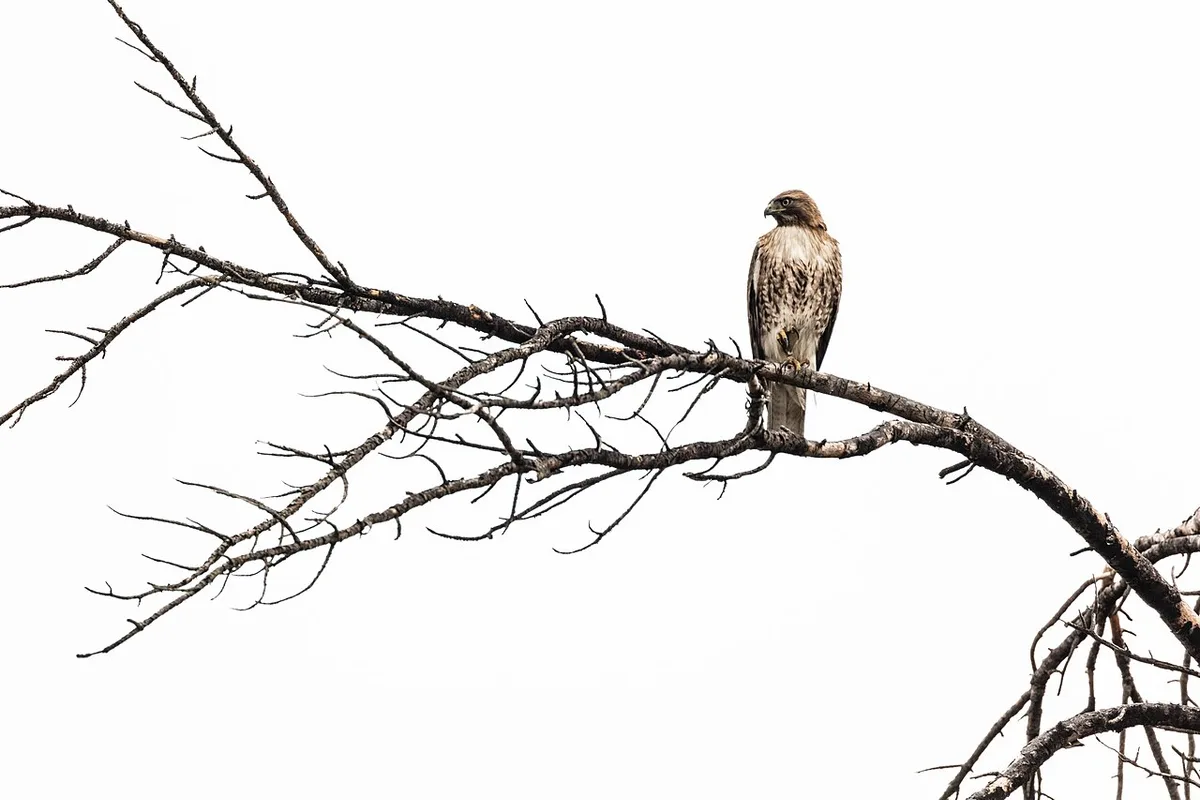
Image source: Wikimedia Commons / Jacob W. Frank
Focusing on the overall shape and behavior is more reliable than color. A red-tailed hawk has a bulky, heavy look compared to the sleeker, more aggressive accipiter hawks. They often soar in wide circles, using thermals to maintain altitude without flapping their wings.
Decoding the Silhouette: Visual Cues for Accurate Identification
The most consistent way to identify a red-tailed hawk is by studying its silhouette against the sky. They possess wide, rounded wings that create a distinctive blocky shape. This makes them look like a flying brick from a distance.
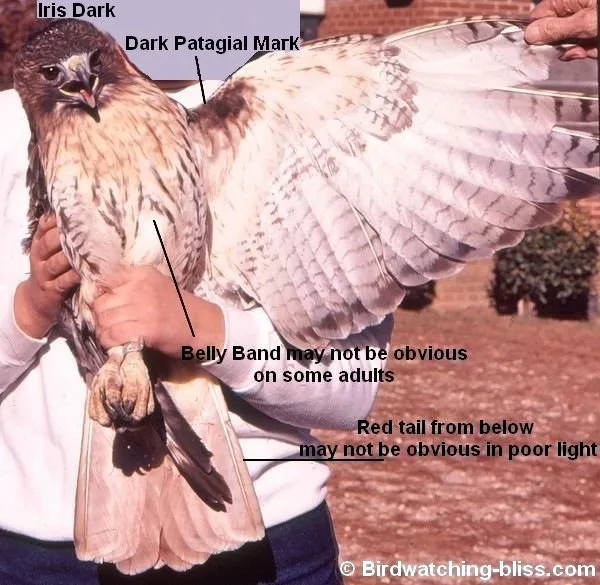
Image source: Web (Bing) / birdwatching-bliss.com (Web image (fair-use with source credit))
When you have a closer view from below, look for the belly band. This is a cluster of dark, streaky feathers across the midsection of an otherwise pale underside. This feature is present on most individuals and serves as a primary identifier.
Additionally, keep an eye out for the patagial bars. These are dark patches at the leading edge of the underwing, right where the wing connects to the body. No other common hawk possesses this specific marking, making it a definitive sign for birders.
Comparing the Red-Tail: Distinguishing Common Look-Alikes
Confusion often arises between the red-tailed hawk and other common raptors like the Cooper’s hawk or the red-shouldered hawk. Each species occupies a slightly different niche, which helps in narrowing down your identification.
| Feature | Red-Tailed Hawk | Cooper's Hawk |
|---|---|---|
| Primary Wing Shape | Broad and rounded | Short and rounded |
| Tail Length | Short and wide | Long and narrow |
| Hunting Habitat | Open fields, roadsides | Wooded areas, backyard feeders |
| Flight Style | Soaring, slow flapping | Quick, agile, stealthy |
Cooper’s hawks are much smaller and rely on agility to navigate through dense tree branches. If you see a hawk hunting in a thick forest or chasing songbirds in a garden, it is rarely a red-tailed hawk. The red-tail prefers open territory where it can scan large areas for ground movement.
Understanding the "Perch and Scan" Hunting Strategy
The red-tailed hawk is a master of energy efficiency. Instead of active flight, they spend the majority of their day perched on high, open vantage points. This strategy is known as "perch and scan" hunting.
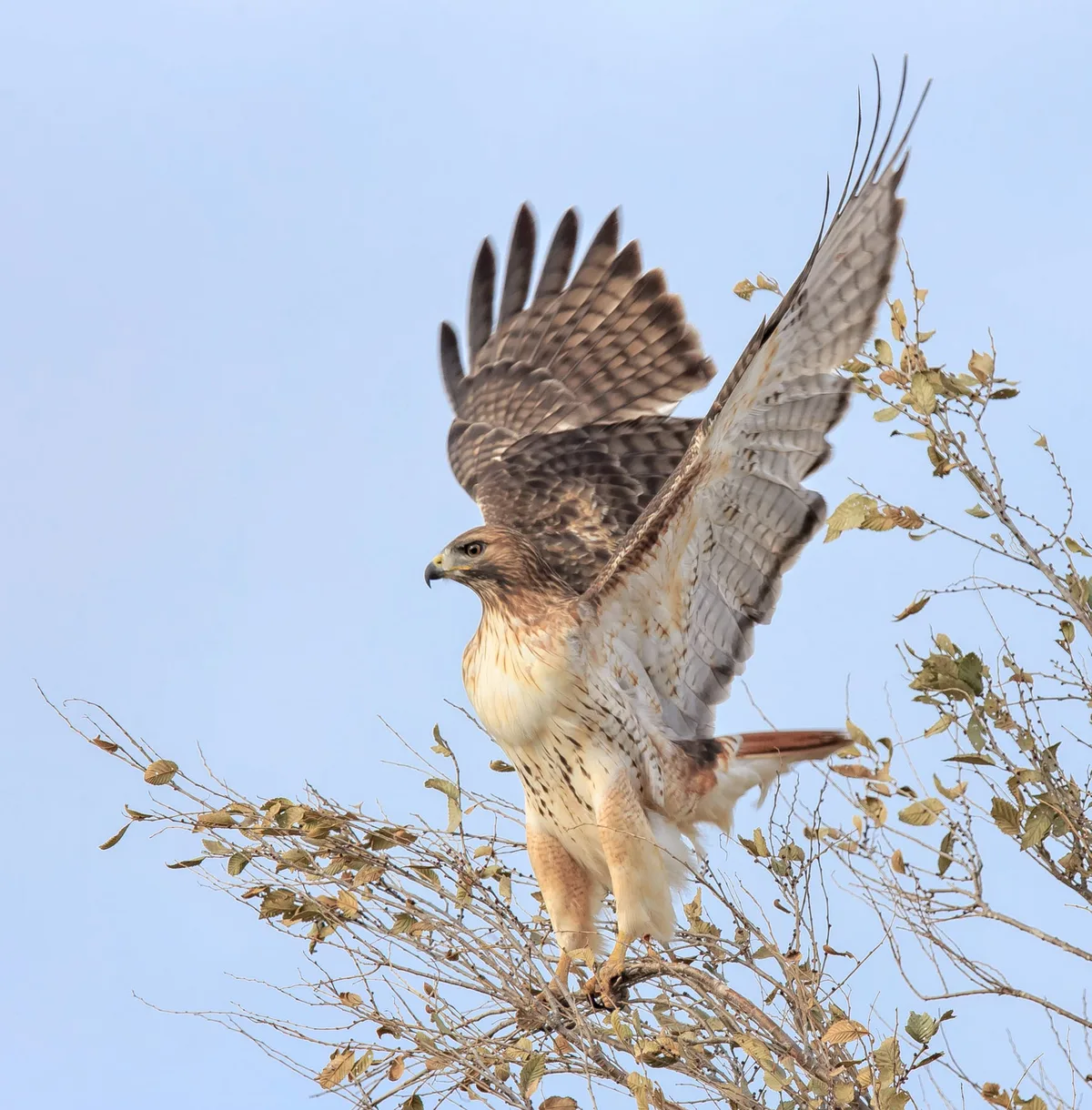
Image source: Web (Bing) / audubon.org (Web image (fair-use with source credit))
They utilize utility poles, dead trees, or billboard signs to gain a clear view of the surrounding grass. Their vision is exceptionally acute. They can spot a small movement in the grass from over 100 feet away.
Once prey is spotted, they drop from the perch in a controlled glide. They use their weight and momentum to secure small mammals. This hunting method requires significant patience, but it allows them to save caloric energy for nesting and migratory activities.
The Reality of Raptor Behavior and Human Interactions
Red-tailed hawks are highly adaptable to human-altered landscapes. You will often see them thriving near highway corridors and agricultural fields. While they are bold predators, they generally remain indifferent to humans unless their nest is approached.
Aggression usually only occurs during the nesting season if an observer gets too close to the nest site. Experts at the U.S. Fish and Wildlife Service suggest maintaining a significant distance if you see signs of a nest.
This prevents the birds from becoming stressed or abandoning their young.
Furthermore, these hawks provide a natural service by controlling rodent populations. In many areas, they are considered beneficial partners in ecological balance. If you see them perched in your neighborhood, appreciate them as effective, natural pest controllers.
Protecting the Species: Legal Standards and Ethical Observation
You must treat all wild raptors with caution and respect to ensure their survival and your own safety. In the United States, the Migratory Bird Treaty Act provides strict protections for red-tailed hawks. It is illegal to capture, kill, or possess any part of these birds, including their feathers, eggs, or nests.
Always maintain a distance of at least 100 yards if you discover a nest. Using a high-powered camera lens is the best way to capture quality images without alerting the birds to your presence. If you notice a hawk acting defensive, such as diving or screeching, you are too close.
Retreat immediately to minimize the stress on the nesting pair.
Avoid using chemical rodenticides in your yard if you live near nesting hawks. These toxins build up in the food chain and can lead to secondary poisoning if a hawk consumes an affected rodent. Opt for snap traps or exclusion methods instead to keep your property free of pests while protecting local wildlife.
Frequently Asked Questions About Red-Tailed Hawks
Do red-tailed hawks eat household pets?
Red-tailed hawks primarily focus on small rodents like voles, mice, and gophers. While they are opportunistic hunters, they rarely target cats or dogs. You should keep small pets supervised regardless, but they are not the typical prey item for these birds.
Why do red-tailed hawks screech at eagles?
The iconic "screech" often associated with bald eagles in movies is actually the call of a red-tailed hawk. Filmmakers dubbed the sound in because the actual vocalization of a bald eagle is a high-pitched chirping sound. They do not necessarily have a specific rivalry with eagles.
How long do these hawks live in the wild?
A typical red-tailed hawk can live for 10 to 15 years in the wild. Survival rates are lowest during the first year of life when young hawks are still learning to hunt. After they reach maturity, they are hardy birds that adapt well to various climates.
Can I feed a red-tailed hawk?
You should never attempt to feed wild raptors. Providing food can cause them to lose their natural fear of humans and alter their hunting behaviors. It is best to let them fulfill their role in the ecosystem by hunting naturally.
Where should I look to find them?
Scan high, open points such as telephone poles, light posts, and the tops of dead trees. They prefer visibility over dense cover. Look along highway corridors or edges of large fields, especially during the early morning or late afternoon when they are actively scanning for prey.