How to Identify a Bird Nest
If you've ever found a clump of sticks wedged in a tree fork or a mud pellet stuck under your eave, learning how to identify a bird nest starts with four things: shape, location, materials, and timing. Most misidentifications happen because people skip one of those cues and guess the rest.
Identifying a nest correctly matters. As of 2026, every native bird species in the U.S. is protected under the Migratory Bird Treaty Act of 1918, enforced by the U.S. Fish and Wildlife Service.
Even an old-looking nest can carry legal consequences if you disturb it without a permit. Here's how to read a nest like a seasoned field observer.
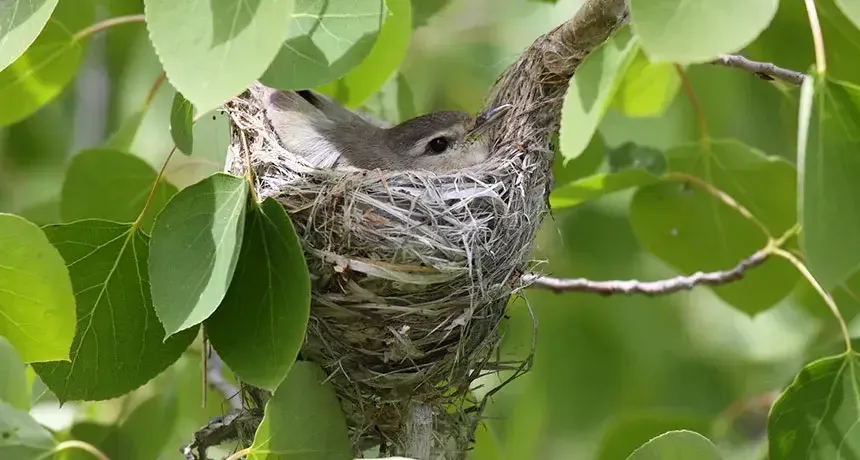
Image source: Bing (Web (fair-use with source credit))
Quick Answer
How to identify a bird nest involves checking its shape, location, materials, and contents. Start with the nest shape: cup, dome, platform, pendulous, tube, or scrape. Then confirm the location relative to ground height and attachment point.
Cross-reference materials and breeding season timing. Finally, match the nest to the species using egg shape or adult bird presence.
Why People Get Bird Nests Wrong
The most common mistake is assuming the adult bird sitting on the nest is the species that built it. Brown-headed cowbirds, for example, lay eggs in other species' nests without building their own. You could watch a bird incubating and still be wrong about who owns the nest.
Location compounds the error. People find a nest cavity in a fence post and immediately assume it belongs to a bluebird. Or they spot a mud structure under a barn eave and call it a barn swallow without checking dimensions.
Both guesses can be right. Both can also miss the mark.
The problem is that nest shape alone narrows the field but doesn't get you to species. A cup nest could belong to dozens of North American songbirds. You need at least three independent cues working together before you make a confident identification call.
That's what this guide walks through. In our research of ornithology reference materials from the Cornell Lab of Ornithology, the four-cue framework (shape, location, materials, timing) is the most reliable method for field identification. Here's how to apply each cue.
The Four Cues That Identify Every Bird Nest
Every bird nest can be read through four independent cues. Miss one and your identification stays uncertain. Stack all four and you'll narrow the species list dramatically.
Cue 1: Nest shape. The architecture tells you what group you're looking at. Cup nests, dome nests, platform nests, pendulous hanging nests, tube nests, mud structures, and ground scrapes each point to a different family of birds. A woven pendant basket almost always means weaverbird or oriole.
A flat stick platform means raptor.
Cue 2: Nest location. Height, attachment point, and surrounding habitat all matter. Ground scrapes suggest shorebirds or raptors. Hanging nests in shrubs suggest orioles.
Mud pellets under eaves suggest swallows. Cavity nests at eye level suggest nuthatches, chickadees, or woodpeckers.
Cue 3: Nest materials. The building materials are species-specific signatures. Mud pellets, spider silk, lichen, human-made fibers, bark strips, grass stems, and feathers each narrow the field. A woven grass nest with spider-silk binding points to a finch.
A mud-plastered structure under a bridge means swallow.
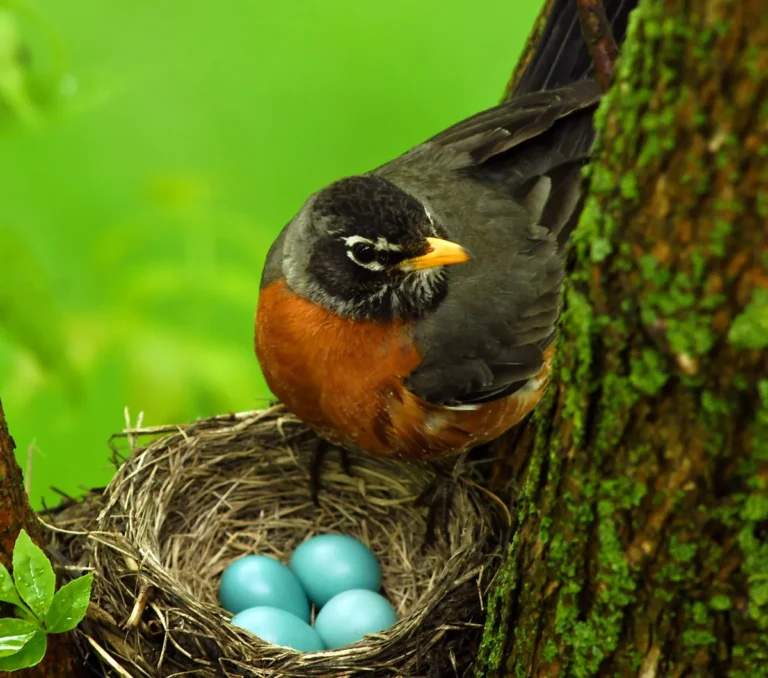
Cue 4: Timing and contents. Breeding season dates, egg count, egg size, and egg color are the strongest confirmation signals. A nest with three to five speckled eggs in a cup found in a garden between March and July points directly to American robin.
The Decision Tree: Narrow the Nest by Shape, Location, and Materials
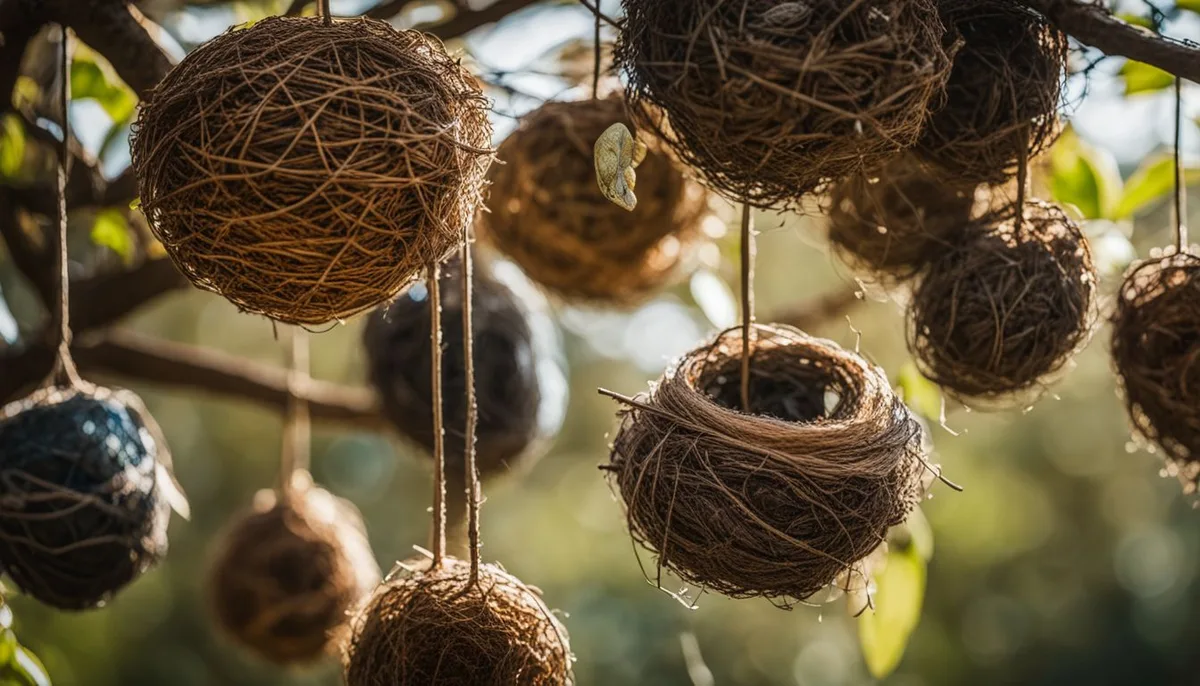
Image source: Bing (Web (fair-use with source credit))
A decision tree turns identification from guessing into a step-by-step narrowing process. Here's the tree to follow in the field.
Start: Where is the nest located?
- On the ground (scrape): Likely shorebird, quail, raptor, or grouse. Check egg count and ground vegetation.
- In a tree cavity or nest box: Likely nuthatch, chickadee, woodpecker, owl, or bluebird. Check cavity diameter and entrance size.
- Under a building eave or bridge: Likely barn swallow, cliff swallow, or chimney swift. Check for mud pellet construction.
- Hanging in a shrub or tree: Likely oriole, weaverbird, or certain warbler species. Check for a woven pendant shape.
- Flat stick platform high in a tree: Likely raptor (eagle, hawk, osprey). Check platform diameter and nest density.
- Cup in a shrub or small tree: Likely songbird (robin, sparrow, finch, thrush). Check cup depth and materials.
Next: What's it made of?
Mud-dominant structures narrow you to swallows and ovenbirds. Woven grass narrows to weavers and sparrows. Bark and lichen narrow to hummingbirds and certain finches.
When three or more cues agree, you've got a strong species candidate.
How to Confirm the Species: Eggs, Adult Birds, and Timing
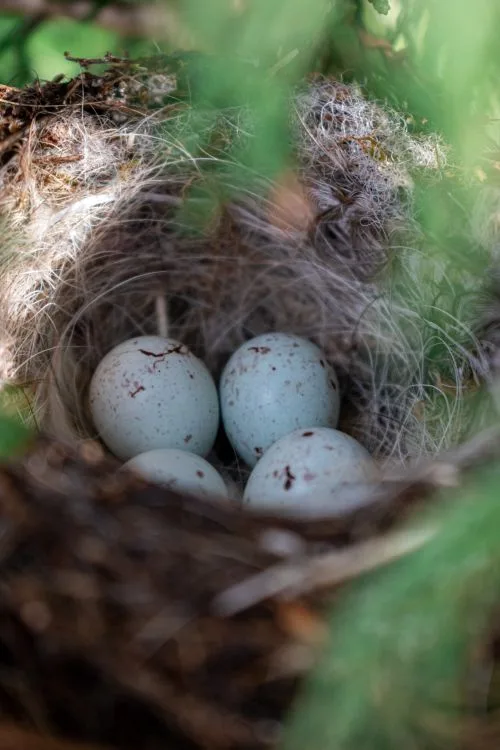
Image source: Bing (Web (fair-use with source credit))
Shape and materials get you to a bird family. To confirm species, you need three more signals.
Eggs are the strongest confirmation. Egg count, size, color, and speckling pattern are species-specific. A house wren lays five to eight small white eggs. An American robin lays three to five blue eggs.
A hummingbird lays exactly two tiny white eggs in a cup barely an inch across. Cornell Lab's NestWatch database publishes egg profiles for over 300 North American species.
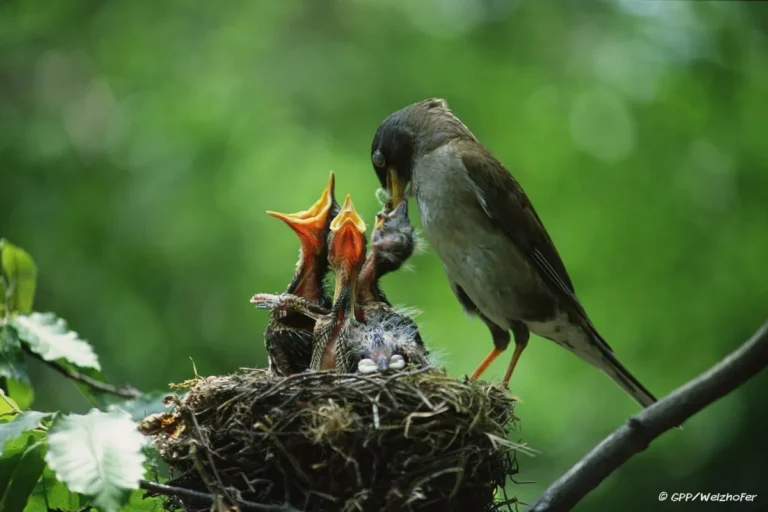
Adult bird presence. If you can observe the species feeding young or incubating, that's your strongest confirmation. Just remember: brood parasites like cowbirds sit on nests they didn't build.
Timing. Most North American songbirds breed between March and July. Southern species may nest year-round. Finding a cup nest with eggs in October in New York means something unusual is happening.
Timing doesn't confirm a species on its own, but it filters out possibilities fast.
Common Mistakes That Lead to Misidentification
Mistake 1: Confusing bird nests with animal nests. Squirrel dreys (leaf and bark nests high in trees), insect galls, and even fungus can mimic bird nest architecture. Drey nests are denser, less structured, and usually placed higher in trees. If the structure has no cup interior or lining, it's probably not a bird nest.
Mistake 2: Assuming the first bird seen owns the nest. Cowbirds, cuckoos, and certain parasitic species visit nests they didn't build. Always identify eggs and nestling plumage before concluding ownership.
Mistake 3: Identifying from a single cue. Cup nests alone don't tell you the species. Location alone doesn't either. You need shape plus materials plus location working together.
One cue is a hint. Three cues is a solid identification.
Mistake 4: Ignoring nest abandonment. An old, damaged, or empty nest may look abandoned. But an empty cup in June could mean hatchlings just fledged, not that the nest is dead. Timing context matters.
Mistake 5: Missing non-native pest species. European starlings, house sparrows, and rock pigeons build nests that look similar to protected native species. If you need to remove a nest from a building, identify the species first. Pest species management follows different rules than protected native birds.
Nesting Laws: What You Can Legally Do Once You've Identified a Bird Nest
Every native bird nest in the U.S. is protected under the Migratory Bird Treaty Act of 1918. That law prohibits disturbing, removing, or destroying active nests without a permit from the U.S. Fish and Wildlife Service.
It's one of the most commonly violated wildlife laws, often by accident.
The key question isn't whether you found a nest. It's whether that nest is active. An active nest has eggs, nestlings, or an adult bird present.
The Migratory Bird Treaty Act protects active nests and their contents. Abandoned nests are a gray area, and determining abandonment accurately is harder than most people think.
Here's what that means in practice:
- Active nest on your property: You cannot touch it, move it, or destroy it without a permit.
- Nest with eggs or nestlings: Strongest legal protection. Report to your state wildlife agency if you need to address it.
- Empty nest, unknown age: Do not assume it's abandoned. Wait for confirmation from a wildlife professional.
- Non-native pest species: European starlings, house sparrows, and rock pigeons are not protected under the MBTA. Nest removal rules differ for these species.
State and local regulations add another layer. Some states protect species that aren't federally listed. The UK Wildlife and Countryside Act 1981 and the EU Birds Directive follow similar principles with their own enforcement structures.
If you need to remove a nest from a building, contact your state Department of Fish and Wildlife first. Many states provide free nest identification and permit guidance over the phone.
Pro Tips for Faster, More Accurate Nest Identification
Experienced field observers follow a set of habits that speed up identification dramatically. Here are the ones that make the biggest difference.
Start with location, not shape. Your first question should be "where is this nest?" not "what does this nest look like?" Location cuts the candidate list faster than any other single cue. A nest under your eave and a nest in a tree fork belong to entirely different bird families.
Learn three nest families cold. Cup nests, cavity nests, and platform nests cover the vast majority of nests you'll encounter in North America. Master those three architectures first. Once you can confidently place a nest into one of those families, adding species-level identification gets much easier.
Check the breeding calendar against your region. Timing alone eliminates dozens of species. A cup nest with blue eggs found in a garden in April almost certainly means American robin. A cavity nest in a dead tree in Minnesota in February could mean great horned owl, which nests earlier than most species.
Use binoculars, not your hands. Keep your distance. Every nest inspection from close range risks disturbing the bird and potentially violating the Migratory Bird Treaty Act. A good pair of 8×42 binoculars lets you read cup depth, material texture, and egg color from 20 to 30 feet away.
Record what you see before you conclude anything. Note the location, the nest shape, the materials you can identify, and the time of year. Write it down or log it in a nest-monitoring app like NestWatch before you try to name the species. Rushing to an ID based on a single glance is how misidentifications happen.
Photograph from multiple angles. Take shots of the nest from the side, from above, and from the entry point if possible. Photograph the surroundings too. Habitat context helps confirm identification later when you're cross-referencing field guides.
Trust materials over memory. A woven grass cup bound with spider silk is finch-family architecture. You'll remember that detail after studying a guide, but you won't reliably recall it from memory alone. Materials are objective.
Memory isn't.
Learn the exceptions before they confuse you. Some species build nests outside the typical breeding window. Weaverbirds construct elaborate nests to attract mates even when no eggs will be laid. Chimney swifts build cup nests from saliva-bound plant fibers in late spring.
Knowing the exceptions prevents you from second-guessing a correct ID.
Cross-reference more than one field guide. Different guides emphasize different visual cues. The Sibley Guide to Birds highlights nest architecture differently than the National Audubon Society's bird profiles. When a nest is ambiguous, two independent references give you a more reliable answer than one.
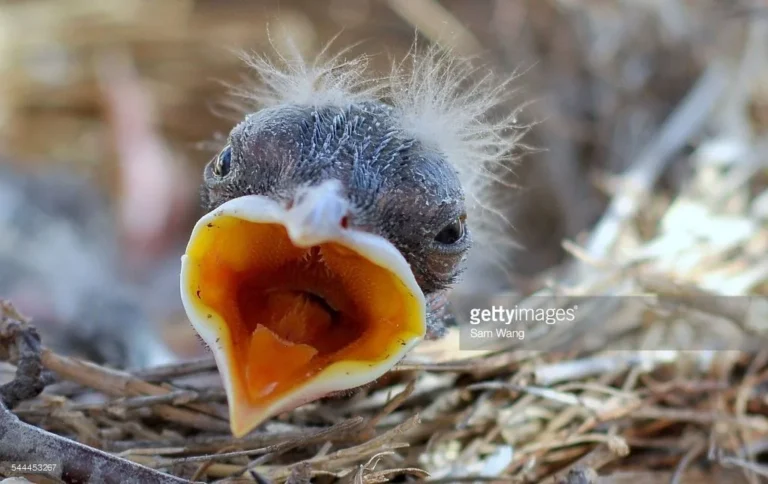
Learn to read nestlings as they grow. Hatchling plumage changes fast. A robin nestling looks very different at day 5 than at day 12. Knowing what fledglings look like at each stage helps you confirm species even when the nest itself is ambiguous.
Cornell's NestWatch species profiles include stage-by-stage development photos.
Frequently Asked Questions
How do you know if a bird nest is active?
An active nest contains eggs, nestlings, or an adult bird actively attending it. You'll also see signs like fresh fecal sacs around the rim, food being carried in, or alarm calls from a nearby adult. A nest that's empty and undamaged might just be between clutches.
Wait a few days before assuming it's abandoned.
Can I remove a bird nest from my house?
Only if the nest is abandoned, or if the species is a non-native pest such as European starlings, house sparrows, or rock pigeons. Active nests of native species are protected under the Migratory Bird Treaty Act. Contact your state wildlife agency before attempting any removal.
They often provide permits and free guidance.
What's the difference between a bird nest and a squirrel nest?
Squirrel nests (called dreys) are dense, compact bundles of leaves and bark, usually high in trees. Bird nests have a defined cup interior and visible lining materials like feathers, grass, or lichen. If you can see eggs, nestlings, or a clear cup shape, it's a bird nest.
What time of year can you find bird nests?
Most North American songbirds build and use nests between March and July. Some species like great horned owls nest as early as February. Tropical and southern species may nest year-round.
Finding a nest outside the expected breeding window means either an unusual species or a non-breeding structure like an unoccupied weaverbird nest.
How long does a bird nest stay in use?
Many songbird nests are used once per season, but some species reuse the same structure. American robins may raise two or three broods in a single nest during one summer. Barn swallows return to the same eave location year after year.
Raptor platform nests can be reused for decades.
Do bird nests ever contain human-made materials?
Yes. Birds frequently incorporate string, plastic bits, cigarette butts, fishing line, and carpet fibers into their nests. Some species even use cigarette butts intentionally to reduce parasites.
Human-made materials are common in urban and suburban nests and don't affect identification. Material composition still narrows the species list.