Flamingo Facts
Flamingos are some of the most recognizable birds on Earth, and learning about them goes far beyond their status as colorful lawn ornaments. These specialized waterbirds have evolved to thrive in environments that would be fatal to most other creatures.
If you are hunting for accurate flamingo facts, it helps to look at the biology behind their striking color and unique physical adaptations. As of 2026, researchers continue to study these animals to understand how they survive in hyper-saline conditions.
Quick Answer
Flamingos are social waterbirds known for their vibrant pink plumage. They filter-feed using specialized beaks to extract food from water. Their signature pink color comes from carotenoid pigments in their diet.
They often stand on one leg to regulate their body temperature. These birds typically inhabit harsh, saline, or alkaline lake environments worldwide.
Why Flamingo Anatomy Looks So Strange
When you look at a flamingo, your brain might struggle to categorize what you are seeing. Their long, spindly legs and S-shaped necks are extreme evolutionary designs. These features allow the birds to wade into deep water while keeping their bodies dry and their food sources within reach.
The anatomy of a flamingo is built for reach and efficiency. Their legs are proportionally longer than those of any other bird in relation to their body size. This is not just for show.
The length helps them forage in deeper water where competition for food is lower.
The Science Behind the Vibrant Pink Feathers
Many people mistakenly believe that flamingos are born pink or that the color comes from simple shrimp consumption. While brine shrimp are a common food source, the reality is a biochemical process involving carotenoids. These are organic pigments found in various algae and aquatic invertebrates.
As a flamingo eats these organisms, their digestive system breaks down the pigments. The bird then deposits these compounds into their growing feathers and skin. If a flamingo lacks access to this specific diet, its feathers will turn pale, eventually becoming white or gray.
- Color Intensity: Brighter feathers indicate a healthier bird with access to high-quality food.
- Juvenile Appearance: Young flamingos hatch with dull gray or white down.
- Dietary Link: Their color acts as a direct visual record of their recent nutritional intake.
Decoding the One-Legged Stance and Thermoregulation
The most iconic flamingo behavior is the single-leg stand. You might assume it is for balance, but it is primarily a tool for thermoregulation. Birds lose a significant amount of body heat through their unfeathered legs.
By tucking one leg up into their dense belly plumage, they reduce the surface area exposed to the air or cold water. This helps the bird maintain a stable core temperature during chilly mornings or while standing in cool, saline lagoons.
Their joints are also remarkably efficient. A flamingo can lock its leg into a standing position without relying on constant muscle engagement. This stay apparatus allows them to rest and even sleep while standing on one leg without burning significant energy.
Filter-Feeding: How They Thrive in Toxic Water
Flamingos occupy a biological niche that few other animals can touch. They live in alkaline lakes and saline lagoons where the water is often caustic enough to burn the skin of other creatures. They have evolved thick, protective skin on their legs to handle these conditions.
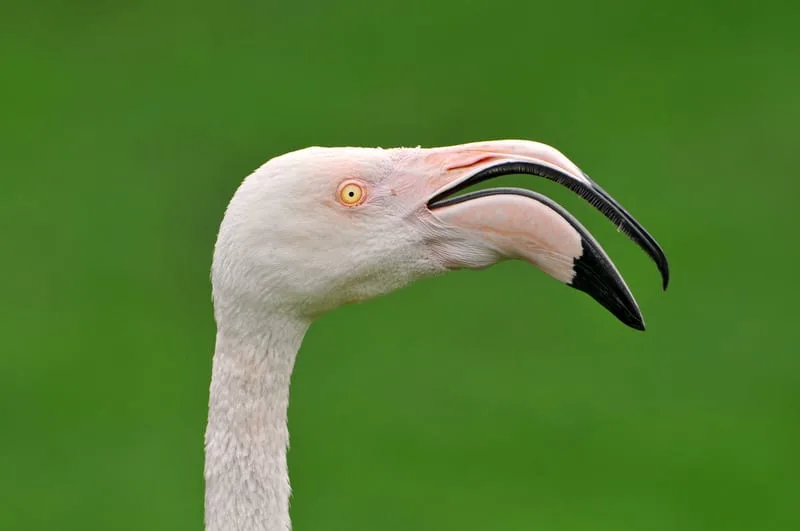
Image source: Bing (Web (fair-use with source credit))
They feed by plunging their heads underwater upside down. The beak acts as a sophisticated pump, drawing in water and mud.
| Feature | Function |
|---|---|
| Beak Shape | Curved downward to scoop in the inverted position. |
| Lamellae | Tiny, comb-like filters that trap prey while letting water escape. |
| Tongue | Acts like a piston to suck water through the filter. |
The Wildfowl & Wetlands Trust highlights that this specialized system allows them to process vast amounts of water to catch tiny brine shrimp and algae. This method of feeding is incredibly efficient for harvesting small prey in high volumes.
Social Dynamics and the Famous Flamboyance
Flamingos are never meant to be solitary. Living in a colony, often called a flamboyance, is a critical survival strategy. These groups can number in the thousands, providing safety in numbers against predators.
The social structure also plays a huge role in their reproductive success. A flamingo colony often engages in synchronized displays, where hundreds of birds move and call in unison. This behavior is essential for stimulating the hormonal changes required for breeding.
Without the visual and auditory cues from a large crowd, individual birds often fail to initiate nesting. They rely on the collective energy of the group to synchronize their life stages. This is why conservation efforts focus on protecting the entire habitat rather than just individual birds.
Busting Common Myths About Flamingo Biology
You’ve likely heard that flamingos get their color exclusively from eating shrimp. While it is true they consume brine shrimp, it is only one part of the dietary puzzle. The core issue is the intake of carotenoids found in various blue-green algae and other aquatic organisms.
Another frequent mistake is the anatomy of their legs. People often see the middle joint bending backward and assume it is a knee. It is actually the ankle joint.
The knee is tucked much higher, near the body, hidden by feathers.

Image source: Bing (Web (fair-use with source credit))
When you examine the structure of their legs, you’ll notice they are surprisingly sturdy. They can endure extreme saline conditions that would burn the skin of other animals. This adaptation is a defensive feature that protects them from predators who cannot cross the caustic water to reach the nests.
Essential Facts for Understanding Wetland Survival
Flamingos are master survivors in environments that are effectively toxic to most other species. Their success depends on their ability to handle high salt concentrations and extreme alkalinity. These wetlands are often the only places where flamingos face little competition for food.
- Evaporation cycles: These birds often follow the water levels of salt lakes.
- Mineral tolerance: They possess specialized glands that help them excrete excess salt from their bodies.
- Breeding triggers: Nesting usually begins when water levels hit a specific depth, which naturally protects the chicks from land-based predators.
Maintaining these wetlands is essential for the future of these birds. The Convention on the Conservation of Migratory Species tracks the status of these habitats, noting that local hydrology changes pose a major threat. If a lake dries up or the salinity balance shifts, the food source disappears and the entire colony must relocate.
Frequently Asked Questions About Flamingos
How long do flamingos live in the wild?
Flamingos are long-lived birds. While predators and harsh environments take their toll, individuals in the wild can regularly reach 20 to 30 years of age. Those in managed care settings with consistent nutrition and veterinary oversight have lived well past 50 years.
Do flamingos actually feed their chicks milk?
It sounds bizarre, but yes, they produce a substance called crop milk. Both parents produce this protein-rich secretion from their upper digestive tract. It isn't like dairy, but it provides the exact nutrients a growing chick needs until its beak is developed enough for filter-feeding.
Why are flamingos never seen sitting down?
They actually do sit, though they prefer to stand. You’ll mostly see them sitting when they are brooding eggs or resting for long periods. Standing is simply their default energy-saving mode for the long hours they spend foraging in the water.
Can flamingos fly?
They are strong, capable fliers. Despite their awkward appearance on the ground, they can reach speeds of 35 to 40 miles per hour during migration. They often fly in large flocks to cover massive distances between feeding grounds.
Are all flamingos the same species?
There are six distinct species of flamingos found across the world. They range from the Greater Flamingo, which is widespread, to the smaller Andean and Puna flamingos that live in high-altitude environments. Each species has adapted to its specific local climate and food sources.