Mute Swan Facts
Learning how to identify Mute Swans is a great way to better understand your local wetlands and park ponds. These large birds have a unique elegance, but they also possess a strong personality that you should know about before you visit.
Understanding mute swan facts helps you appreciate these birds while staying safe during their active seasons. As of 2026, researchers consider them a non-native species in many North American freshwater regions. They often stand out because of their distinct size and specific, somewhat grumpy, behavior near their nests.
Quick Answer
The Mute Swan is a large, white, non-native waterfowl species. They feature an orange bill and a black fleshy knob. These birds are known for their territorial behavior during nesting season.
They do not have the loud, bugling calls of other swans. They primarily feed on submerged aquatic vegetation in shallow ponds.
Spotting the Mute Swan: Visual Cues and Identification
If you’re walking near a lake or pond, the Mute Swan is usually easy to spot because of its size and bright white plumage. They are significantly larger than most ducks or geese, often weighing up to 25 pounds. You’ll notice they swim with a distinct, graceful curve in their necks, forming a shape that looks like an S.
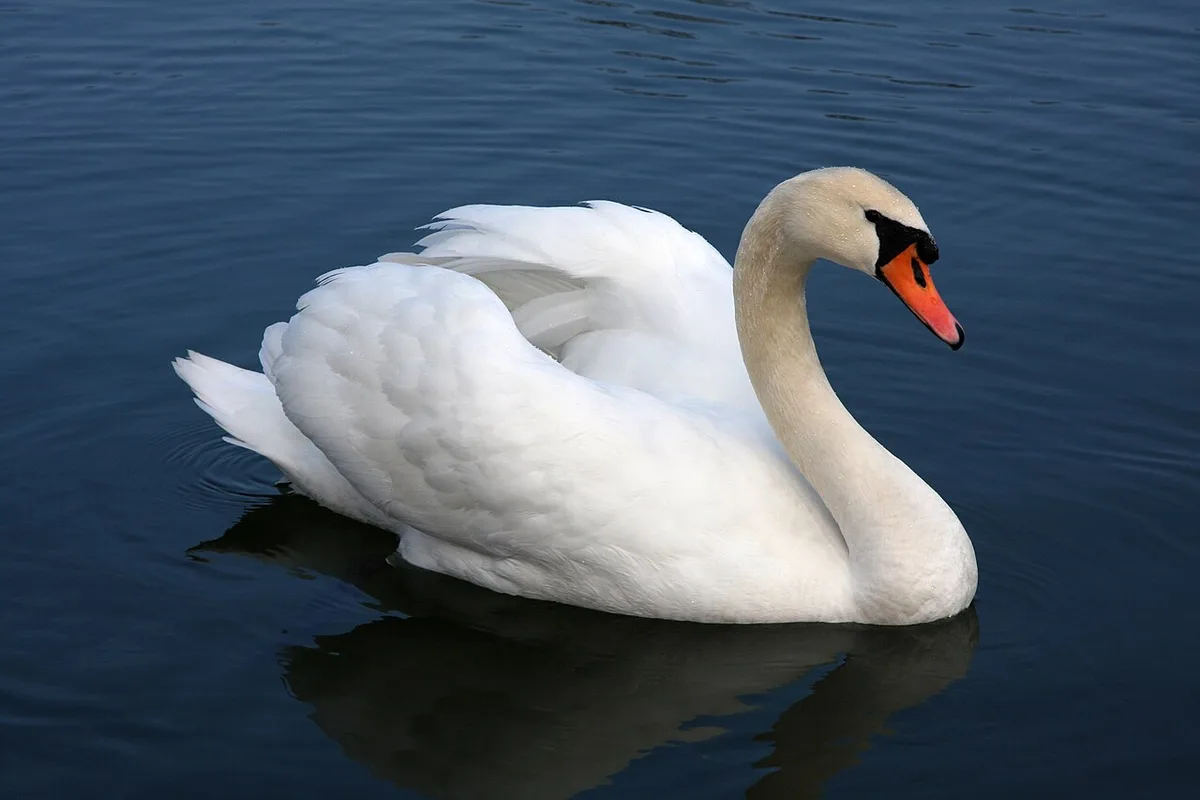
Image source: Wikimedia Commons / Yerpo (CC BY-SA)
Other swan species, such as the Tundra or Trumpeter swan, tend to hold their necks much straighter. When the Mute Swan is at rest on the water, they often hold their wings slightly arched over their backs. This look, often called busking, is a classic identification marker.
It’s also a hint that the bird is keeping a close watch on its surroundings.
Anatomy of the Mute Swan: Key Physical Traits
The most reliable way to confirm you’ve found a Mute Swan is by inspecting the bill. Adult birds have a vivid orange-red bill that stands out against their stark white feathers. At the base of that bill, you’ll see a black, fleshy growth known as a basal knob.

Image source: Bing (Web (fair-use with source credit))
This knob is more prominent on males, which are called cobs, compared to females, known as pens. According to data from the Cornell Lab of Ornithology, these physical traits remain consistent throughout the year. You won't see this specific knob structure on native North American swan species, which makes it an excellent diagnostic feature for amateur birdwatchers.
The juveniles, or cygnets, look quite different from their parents. They are usually a dusty grey or brown color during their first year. They also lack the dark basal knob and have much duller, greyish bills.
It can take them up to two years to transition into the bright white plumage of the adults.
Understanding Mute Swan Behavior and Territoriality
Mute Swans are famously territorial, especially when they are raising their young. During the spring nesting season, they become protective parents. They view any animal or person that wanders too close to their nest as a potential threat.
If you encounter one, watch for these defensive signals:
- Hissing: This is their primary way of saying stay back.
- Wing Arching: Raising their wings high while swimming toward you.
- Rapid Swimming: Moving quickly across the water to intercept perceived intruders.
When they feel threatened, they might grunt, snort, or hiss to deter the danger. While they are often peaceful toward other birds during the winter, they shift to a much more aggressive stance as soon as their eggs start to hatch. Respecting their space during these months is critical for both your safety and the health of the family.
Natural Habitat and Seasonal Life Cycles
These birds are highly adaptable and thrive in a variety of freshwater environments. You’ll often find them in shallow ponds, slow-moving rivers, and sheltered coastal estuaries. They rely heavily on submerged aquatic vegetation for their diet.
You’ll frequently see them upending, which is when they tip their bodies forward to reach the pond bottom with their long necks.
| Season | Typical Mute Swan Activity |
|---|---|
| Spring | Nesting, egg-laying, and high territorial aggression. |
| Summer | Molting and caring for growing cygnets. |
| Autumn | Preparing for migration if local waters freeze. |
| Winter | Gathering in larger, communal groups on open water. |
During the summer months, they go through a molting process where they temporarily lose their flight feathers. This makes them flightless for a few weeks, which explains why they might seem extra grumpy or protective during this time. They are essentially grounded, so they rely entirely on their ability to swim and bluff their way out of danger.
Responsible Birdwatching: Safety and Ethics
The best way to observe Mute Swans is from a distance. If you are using a camera or binoculars, keep at least 30 to 50 yards away. This prevents them from feeling the need to stop their natural behaviors or initiate defensive actions.
If the bird stops feeding or changes its posture to face you, you are too close.
Never feed them bread or human snacks. According to guidance from the U.S. Fish and Wildlife Service, human food causes nutritional deficiencies and can lead to water quality issues in small ponds.
If you want to interact with them, stick to observing them from the trail.
Leave the nesting areas alone, especially those marked with park signage. These sites are often protected to ensure the cygnets survive through their most vulnerable stages. By following these basic ethics, you ensure that the swans remain healthy and that your visit remains a positive, low-stress experience.
Dispelling Myths and Common Misconceptions
One of the most persistent myths is that Mute Swans can break a human arm with a single wing beat. While they are powerful birds, they simply lack the bone density and musculature to cause such severe injury. You might get a nasty bruise or a scratch if you get too close, but the idea of broken bones is purely anecdotal and not supported by biological reality.
Another common misconception is that they are entirely silent birds. While they don't produce the bugling call of a Trumpeter Swan, they are far from mute. They communicate through a range of hisses, soft grunts, and low-frequency snorts.
If you spend enough time near a nesting pair, you will hear them talking to each other quite frequently.
People also often assume that swans mate for life in the romantic sense. It is more accurate to say that they are serial monogamists who value stability for the sake of raising cygnets. If one partner dies or disappears, the survivor will often find a new mate within a single season.
This behavior ensures that the pair can continue to successfully defend their territory and provide food for their offspring year after year.
Frequently Asked Questions About Mute Swans
Can I feed Mute Swans if they look hungry?
You should avoid feeding them bread or processed food, as it lacks the nutrients they need and causes water pollution. If you want to help, choose frozen peas or corn that have been completely thawed. These snacks provide necessary energy without the harmful fillers found in bread or crackers.
How aggressive are Mute Swans to pets?
They view dogs and other small pets as potential predators that threaten their nest or their young. If you are walking a dog near a pond with swans, keep the dog on a leash and stay well away from the water edge. A defensive swan will not hesitate to pursue a pet if it feels its territory is being breached.
Are Mute Swans an invasive species?
In many parts of North America, yes, they are managed as a non-native, invasive species. Because they are highly territorial, they often outcompete native waterfowl for food and prime nesting spots. Many wildlife agencies actively manage their populations to protect local biodiversity and ensure that native habitats remain balanced for indigenous species.
How do I tell a Mute Swan from a Canada Goose?
The difference is immediate in terms of size, color, and posture. A Mute Swan is pure white with an orange bill, while a Canada Goose has a brown-grey body and a black head with a white chin strap. Swans are also substantially larger, often twice the height and weight of even the biggest geese you will find in your local park.
Do Mute Swans migrate?
They don't always migrate long distances if they can find open water and a reliable food source throughout the winter. If their local pond or lake freezes over, they will move to larger, deeper bodies of water nearby to survive. They only migrate further south when they absolutely must to escape harsh weather that locks away their food supply.